
Go
is one of the world’s oldest strategy games, and it still feels fresh today. At first glance, the rules are simple: place stones, surround territory, and try to outscore your opponent. However, the depth is remarkable, which is why many players return to it for years. It is also the abstract strategy board game that helps enhance Strategic thinking, Planning and foresight, Pattern recognition, Decision-making, Adaptability, making it a favorite for both hobby players and serious learners.
Even though it looks minimal, the game creates rich tactical and strategic choices from the very first move. In fact, its balance between simple rules and deep play is a big reason it is studied, taught, and played worldwide. Therefore, if you enjoy thoughtful competition and long-term planning, this classic deserves a closer look.
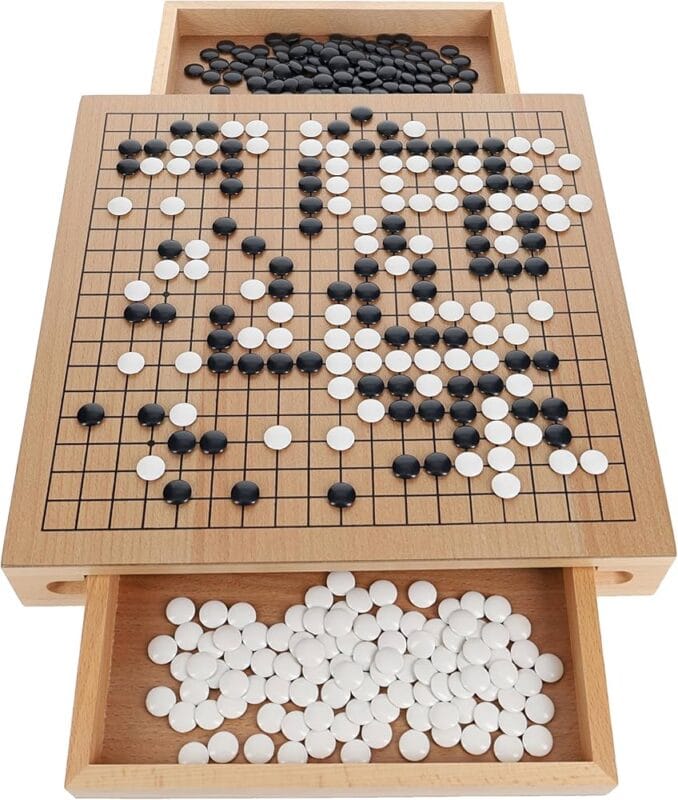
What is Go? An overview
Go is a two-player abstract strategy board game played with black and white stones on a grid board. Players take turns placing stones on the intersections of the lines, not inside squares. The standard board is 19×19, although smaller 13×13 and 9×9 boards are also common for teaching and quicker games.
The goal is to control more territory than your opponent while keeping your own groups of stones alive. Stones do not move after being placed, which means every turn matters. As a result, the game rewards patience, shape awareness, and the ability to read future positions.
History, origin
According to Encyclopaedia Britannica, Go originated in China, where it is known as weiqi, and it is widely considered to be more than 2,500 years old. It later spread to Korea, where it is called baduk, and to Japan, where the name Go became internationally familiar. Over time, formal schools, written theory, and professional systems helped the game develop into a major cultural tradition in East Asia.
Today, it is organized internationally through national and continental associations, and major online platforms have made it easier to learn and compete. Therefore, while its roots are ancient, its modern community is very active.
Versions and editions
The game is available in many physical and digital forms. Physical sets usually include a board, black and white stones, and bowls to hold the stones. Standard sets can range from about $20 to over $200, depending on board material, stone quality, and craftsmanship. Entry-level cardboard or foldable sets are usually the most affordable, while wooden boards with shell-style stones cost more.
It is also available in many languages through rulebooks, apps, and online servers. Common language support includes English, Chinese, Japanese, and Korean, and many digital platforms offer additional European languages. Of course, language needs are modest once you know the rules, because most gameplay is visual.
Platform availability
The game can be played in several ways. First, there are traditional physical sets for table play with no technical requirements. Then, there are web-based platforms and downloadable apps for PC and smartphones. Most digital versions require only a modern browser or a current mobile operating system, although account creation may be needed for ranked play, reviews, or online matchmaking.
- Physical board game: no technical requirements, just a board and stones.
- Web browser: usually works on current Chrome, Firefox, Safari, or Edge.
- PC and Mac: some clients and training tools require download and internet access.
- Android and iOS: many apps support puzzles, local play, or online games.
Audience & age
Go is suitable for a wide audience. Many publishers and teachers introduce it to children from about 6 years and up using smaller boards, while adults can enjoy the full standard game. Because the rules are short but the strategy is deep, it scales well from beginner lessons to advanced competitive play.
It works well for families, classrooms, clubs, and solo study through puzzles. However, younger players often benefit from guided teaching at the start.
Educational Value – What skills does Go develop?
Go is the abstract strategy board game that helps enhance Strategic thinking, Planning and foresight, Pattern recognition, Decision-making, Adaptability. It does this through repeated practice in reading positions, comparing trade-offs, and responding to changing threats across the board.
- Strategic thinking: Players must balance local fights with the overall board. Therefore, they learn to connect short-term tactics with long-term goals.
- Planning and foresight: Good moves often prepare future shapes, territory, or attacks. As a result, players practice thinking several turns ahead.
- Pattern recognition: Repeated exposure to life-and-death shapes, connections, cuts, and corner patterns helps players notice useful structures quickly.
- Decision-making: Every move carries an opportunity cost. Players must choose where to defend, invade, expand, or simplify.
- Adaptability: Opponents can change the direction of the game suddenly. So, players learn to revise plans when the board position shifts.
No advanced prior knowledge is required to start. Beginners only need to learn a few core rules, such as liberties, capturing, and the idea of territory. However, improvement comes from practice, reviewed games, and solving basic problems.
How to play Go?
What does it look like?
A physical set usually includes a grid board, black stones, white stones, and often two bowls. The standard board has 19 horizontal and 19 vertical lines. Smaller teaching boards, especially 9×9 and 13×13, are also widely sold and used.
If you play digitally, the interface replaces the board and bowls with a virtual grid and clickable stones. In that case, you generally need an internet connection for online play, while puzzles or AI practice may work offline depending on the app.
Core concept, gameplay style & mechanics
The core idea is to place stones to surround territory and influence the board while reducing your opponent’s options. Stones of the same color connect along lines, and groups survive by keeping enough liberties, which are empty adjacent points. If a group loses all liberties, it is captured and removed.
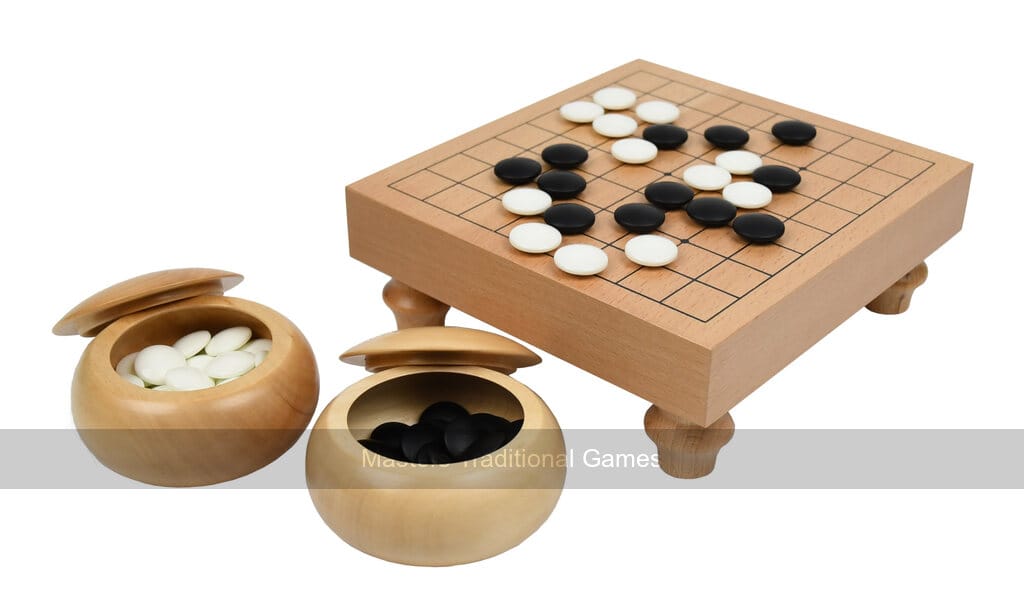
The gameplay is positional and cumulative. Unlike chess, pieces do not move after placement. That means shape, efficiency, and timing matter a lot, and small gains across the board can decide the result.
Objective of the game
The objective is to finish with more territory and overall points than your opponent under the scoring rules being used. In standard play, players also account for captured stones and compensation points called komi, which are given to White in many rule sets to balance Black’s first-move advantage.
Step-by-step basic gameplay loop
- Black plays first, then players alternate turns.
- On your turn, place one stone on any empty intersection, or pass.
- Check whether any opposing group has lost all liberties; if so, remove it.
- Protect your own groups while expanding territory and influence.
- When both players believe no useful moves remain, both pass.
- Count territory and other scoring elements according to the rule set.
Common mistakes
- Playing too close to strength: Beginners often reinforce already safe areas instead of taking bigger points elsewhere.
- Ignoring liberties: Groups can collapse quickly if you do not count breathing space carefully.
- Focusing only on one fight: The whole board matters, so tunnel vision can cost territory.
- Overplaying: Aggressive invasions without support often fail.
Expert tips
- Start with small boards: 9×9 helps you learn captures, shape, and tempo faster.
- Value corners first: They are easier to secure than sides or center.
- Review your games: Post-game analysis is one of the fastest ways to improve.
- Solve life-and-death problems: These sharpen reading and pattern recognition.
Alternative games to Go
If you enjoy deep strategy, Chess is a strong alternative. It also rewards planning, tactical awareness, and positional judgment, although it uses moving pieces with different powers. As a result, it feels more direct and tactical in many positions.
Shogi, often called Japanese chess, is another excellent option. Its drop mechanic creates constant counterplay and complex calculation. Therefore, it appeals to players who like rich strategic systems and dynamic turnarounds.
Go FAQ
Is Go hard to learn?
The basic rules are easy to learn, especially on a 9×9 board. However, mastering the strategy can take a very long time because the number of possible positions is enormous.
How long does a game of Go take?
It depends on the board size and time controls. Beginner games on 9×9 can finish in 10 to 20 minutes, while serious 19×19 games may last much longer.
What is the difference between Go and Chess?
In Chess, pieces move and have different abilities. In Go, stones are placed and usually stay where they are, with strategy focused on territory, influence, shape, and liberties.
Can children play Go?
Yes. Many teachers introduce it to children using small boards and simplified lessons. The rules are accessible, and the game can support concentration and planning.
Do I need to memorize openings?
No. Opening knowledge can help later, but beginners can start by learning basic principles such as corners first, keeping groups connected, and watching liberties.
For further learning and playing
is a coherent next step if you enjoy pure abstract strategy. It removes the board entirely and focuses on spatial tactics, mobility, and piece interaction, which can sharpen positional thinking in a different format.
AlphaGo-inspired trainers are also a natural continuation. They help players study patterns, review games, and explore AI-informed move suggestions. Therefore, they can be especially useful once you know the basics and want structured improvement.
To sum up
Go remains a timeless classic because simple rules lead to extraordinary depth. It is also the abstract strategy board game that helps enhance Strategic thinking, Planning and foresight, Pattern recognition, Decision-making, Adaptability. Whether you start on a small board or dive into full 19×19 play, it offers a rewarding path for lifelong learning.
To play Go
Web browser: https://online-go.com/
PC: https://store.steampowered.com/app/1264970/The_Conquest_of_Go/
Sources of information
American Go Association – What is Go?Online Go Server – Learn to Play GoSensei’s Library
Player Reviews
There are no reviews yet. Be the first one to write one.