
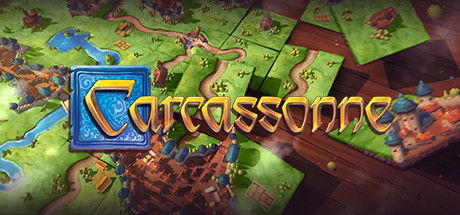
Carcassonne is a captivating tile-laying medieval landscape building game that has enchanted players worldwide since its debut. It’s not just a game; it’s a strategic journey that helps enhance strategic thinking, planning and foresight, pattern recognition, and decision-making. Whether you’re a casual player or a seasoned board gamer, this game offers a perfect blend of fun and mental challenge.
What is Carcassonne? An overview
History, origin
Carcassonne was designed by Klaus-Jürgen Wrede and first published in 2000 by Hans im Glück in Germany. The game quickly gained popularity due to its simple yet deep gameplay mechanics. Named after the medieval fortified town of Carcassonne in southern France, the game reflects the charm and tactical depth of medieval landscape construction.
Versions and editions
Since its original release, Carcassonne has seen numerous expansions and editions, including the base game and many thematic add-ons that introduce new tiles and rules. The base game typically ranges from $25 to $40 depending on the edition and retailer. It is widely available in multiple languages including English, German, French, Spanish, and Italian, making it accessible to a global audience.
Platform availability
Carcassonne is primarily a physical board game but also has digital versions available on PC, iOS, and Android platforms. The digital versions faithfully recreate the tile-laying experience and allow for both single-player and multiplayer modes.
Audience & age
The game is suitable for ages 7 and up, making it a great family game. Its strategic depth also appeals to adults and board game enthusiasts, offering a rewarding experience for players of all skill levels.
Educational Value – What skills does Carcassonne develop?
- Strategic thinking: Players must decide where to place tiles and followers to maximize points, requiring careful planning and adaptability.
- Planning and foresight: Anticipating opponents’ moves and future tile placements encourages looking ahead and adjusting strategies accordingly.
- Pattern recognition: Identifying how tiles fit together to complete cities, roads, and fields helps players make optimal placements.
- Decision-making: Each turn presents multiple options, and choosing the best course of action under uncertainty sharpens decision-making skills.
No prior knowledge is required to start playing, as the rules are straightforward, but understanding the strategic elements can greatly improve gameplay.
How to play Carcassonne?
What does it look like?
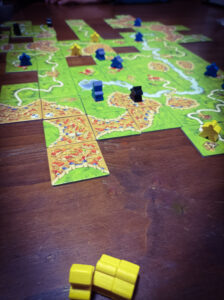
The physical game comes with 72 square tiles depicting various landscape features such as cities, roads, fields, and cloisters. Players also receive wooden follower pieces in different colors to claim features on the board. The digital versions require a compatible PC or mobile device with internet access for multiplayer modes.
Core concept, gameplay style & mechanics
Players take turns drawing and placing tiles to build a medieval landscape. Each tile must connect logically with previously placed tiles. After placing a tile, players may deploy a follower to claim a feature, scoring points as the feature is completed. The game blends tile-laying with area control mechanics.
Objective of the game
The goal is to score the most points by completing cities, roads, cloisters, and fields. Strategic placement of tiles and followers is key to maximizing points while blocking opponents.
Step-by-step basic gameplay loop
- Draw a tile from the stack.
- Place the tile adjacent to existing tiles, matching edges.
- Optionally place a follower on a feature of the placed tile.
- Score completed features immediately.
- Next player’s turn.
Common mistakes
- Placing tiles without considering future expansions.
- Overcommitting followers too early, limiting scoring opportunities.
- Ignoring opponents’ potential moves and blocking strategies.
Expert tips
- Balance between expanding your own features and disrupting opponents’ plans.
- Save followers for high-value features like large cities or cloisters.
- Pay attention to the tile distribution to anticipate upcoming tiles.
Alternative games to Carcassonne
If you enjoy this tile-laying medieval landscape building game, you might also like Tiny Towns and The Castles of Mad King Ludwig. Both games offer unique strategic challenges and engaging gameplay mechanics that appeal to fans of spatial reasoning and planning.
Carcassonne FAQ
What is the best number of players for Carcassonne?
The game plays well with 2 to 5 players. Many find that 3 to 4 players offer the most balanced and interactive experience.
How long does a typical game last?
A standard game usually takes about 30 to 45 minutes, making it a great option for a quick yet engaging session.
Can children play Carcassonne?
Yes, children aged 7 and up can enjoy the game, especially with some guidance. The simple rules make it accessible, while the strategic depth keeps it interesting.
Are there digital versions available?
Yes, Carcassonne is available on PC, iOS, and Android, allowing for solo and multiplayer gameplay on the go.
Does Carcassonne have expansions?
Absolutely. There are many expansions that add new tiles, rules, and gameplay elements to enrich the experience.
For further learning and playing
Cities: Skylines II and Project Highrise are excellent digital successors to the strategic landscape building experience. Cities: Skylines II offers a complex city-building simulation that expands on planning and foresight, while Project Highrise focuses on vertical construction and management, complementing the spatial reasoning skills developed in the game.
Explore more about these games here: Cities: Skylines II and Project Highrise.
To sum up
This tile-laying medieval landscape building game is a timeless classic that combines simple rules with deep strategy. It’s perfect for developing critical thinking skills while having fun with friends and family.