
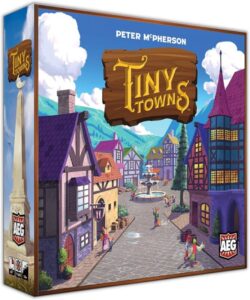
Tiny Towns is a captivating strategy board game of resource management that challenges players to build the most efficient and prosperous little city. This game is perfect for anyone who enjoys planning and foresight, pattern recognition, problem-solving, and decision-making. Whether you are a casual gamer or a seasoned strategist, this game offers a fun and engaging experience that sharpens your cognitive skills while providing hours of entertainment.
What is Tiny Towns? An overview
History, origin
The game Tiny Towns was designed by Peter McPherson and published by AEG (Alderac Entertainment Group) in 2019. It quickly gained popularity for its unique blend of resource management and spatial puzzle mechanics. The game’s design encourages players to think critically about how to place resources and buildings in a limited space, making it a standout title in the strategy board game community.
Versions and editions
Tiny Towns is available in a standard physical board game edition that typically retails between $30 and $50, depending on the retailer and region. The game has been translated into multiple languages including English, German, French, and Spanish, making it accessible to a broad international audience. There are no digital or app versions officially released as of now, focusing the experience on the tactile and social aspects of board gaming.
Platform availability
As a physical board game, Tiny Towns is available in retail stores and online shops worldwide. It is designed for tabletop play and does not have official digital or console versions. This means players can enjoy the tactile feel of the components and the face-to-face interaction that board games uniquely offer.
Audience & age
The game is recommended for players aged 12 and up, making it suitable for teens and adults alike. Its strategic depth appeals to experienced gamers, but the straightforward rules also allow newcomers to quickly learn and enjoy the game. It supports 1 to 6 players, making it versatile for solo play or group sessions.
Educational Value – What skills does Tiny Towns develop?
- Planning and foresight: Players must anticipate future resource needs and building placements to optimize their town layout. This encourages strategic thinking and long-term planning.
- Pattern recognition: Recognizing resource patterns and how different buildings interact spatially is key to maximizing points and efficiency.
- Problem-solving: The game presents spatial puzzles that require creative solutions to fit buildings within a limited grid without wasting resources.
- Decision-making: Each turn involves choosing which resource to place and where, balancing immediate gains with future opportunities.
There is no prior knowledge required to play the game other than basic counting and an understanding of turn-based mechanics. The rulebook is clear and concise, making it easy to learn.
How to play Tiny Towns?
What does it look like?
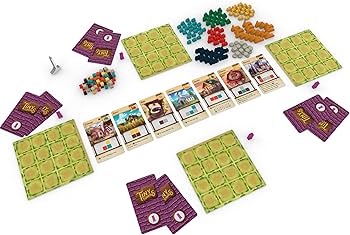
The physical game comes with a wooden board for each player, resource cubes in various colors, building cards, and a rulebook. Each player receives a 4×4 grid board representing their town, and resources are represented by colored wooden cubes. The components are high quality, with bright colors and tactile pieces that enhance the gameplay experience.
Core concept, gameplay style & mechanics
The core concept revolves around drafting resources and placing them on your grid to build buildings according to specific patterns. Each building requires a unique arrangement of resources, and players must carefully plan placement to avoid blocking future buildings. The gameplay is turn-based and involves a mix of resource drafting, spatial reasoning, and tactical planning.
Objective of the game
The main objective is to score the highest points by constructing buildings efficiently on your grid. Points are awarded based on the type and number of buildings completed, with some buildings providing bonus points or special abilities. The game ends when no more buildings can be constructed, and the player with the most points wins.
Step-by-step basic gameplay loop
- All players simultaneously choose a resource cube from a common pool.
- Each player places the chosen resource on their grid.
- When a player completes the pattern for a building, they place the building token on the grid, removing the used resources.
- The game continues until no more resources can be placed or buildings constructed.
- Players tally their points based on buildings and any bonuses.
Common mistakes
- Placing resources without considering future building patterns, leading to blocked spaces.
- Ignoring the strategic value of certain buildings that offer bonus points.
- Failing to adapt when resource choices become limited.
Expert tips
- Plan several turns ahead to avoid dead-end placements.
- Prioritize buildings that fit well with your current resource layout.
- Watch opponents’ boards to anticipate resource availability and adjust your strategy.
Alternative games to Tiny Towns
If you enjoy this game, you might also like The Castles of Mad King Ludwig and Townscaper. Both games offer unique takes on building and city design.
The Castles of Mad King Ludwig is a tile-placement game where players design extravagant castles. It shares the spatial planning and strategic decision-making aspects, making it a great alternative for fans of resource management and pattern recognition.
Townscaper is a relaxing city-building game focused on creativity and aesthetics. While less strategic, it offers a charming experience for those who enjoy building and design.
Tiny Towns FAQ
How many players can play Tiny Towns?
The game supports 1 to 6 players, making it flexible for solo play or group gaming sessions.
What age is Tiny Towns suitable for?
It is recommended for players aged 12 and above due to its strategic depth and complexity.
Is Tiny Towns available in digital form?
As of now, Tiny Towns is only available as a physical board game with no official digital or app versions.
How long does a game of Tiny Towns usually take?
A typical game lasts around 30 to 60 minutes depending on the number of players and their familiarity with the rules.
What are the key skills developed by playing Tiny Towns?
The game enhances planning and foresight, pattern recognition, problem-solving, and decision-making skills.
For further learning and playing
After mastering Tiny Towns, you might want to explore Cities: Skylines II and Project Highrise. These games offer deeper and more complex city-building experiences that build on the resource management and strategic planning skills developed in Tiny Towns.
Cities: Skylines II is a detailed city simulation game where players manage urban planning, infrastructure, and public services on a large scale. It expands the strategic gameplay to a digital environment with more variables and challenges.
Project Highrise focuses on constructing and managing skyscrapers, combining resource management with economic strategy and tenant satisfaction. It complements Tiny Towns by adding layers of complexity and management depth.
To sum up
Tiny Towns is a brilliant strategy board game of resource management that offers an engaging way to develop critical thinking skills like planning, pattern recognition, problem-solving, and decision-making. Its accessible yet challenging gameplay makes it a must-try for anyone interested in strategic city-building games.
Sources
- BoardGameGeek: Tiny Towns
- Alderac Entertainment Group Official Site
- Ultra Board Games: Tiny Towns Rules
Player Reviews
There are no reviews yet. Be the first one to write one.