
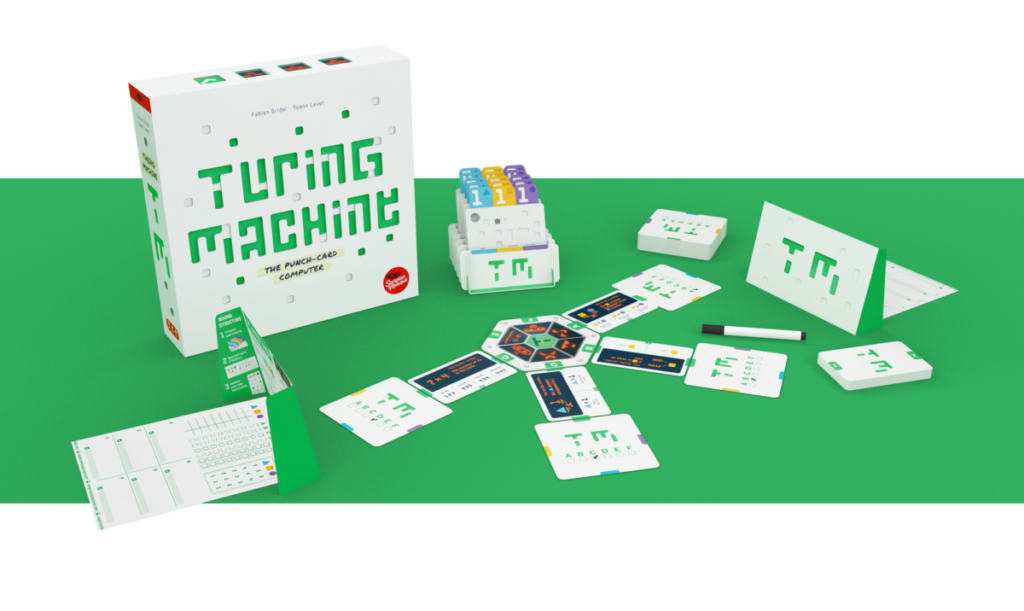
Turing Machine is a fascinating deductive board game simulating a proto-computer, designed to sharpen your mind through engaging gameplay. It challenges players to think like early computer scientists, enhancing skills such as deductive reasoning, problem-solving, mathematical reasoning, strategic thinking, attention, and focus. This unique game offers a blend of education and entertainment, making it a must-try for puzzle lovers and logic enthusiasts alike.
What is Turing Machine? An overview
History, origin
The game draws inspiration from the concept of the Turing Machine, a theoretical device invented by Alan Turing in 1936. This proto-computer laid the foundation for modern computing by formalizing the idea of algorithms and computation. The board game translates this abstract concept into a tangible, interactive experience, allowing players to explore computational logic hands-on.
Versions and editions
The game is available in several editions, typically including a standard board game version with physical components and occasionally digital adaptations. Prices generally range from $30 to $50 depending on the edition and retailer. It is commonly available in English and several other major languages, catering to a global audience interested in educational and strategic games.
Platform availability
The primary version is a physical board game, but some digital versions exist for PC and tablets. These digital versions require a standard modern operating system and a device capable of running casual games smoothly.
Audience & age
The game is best suited for players aged 12 and up due to its reliance on logical thinking and abstract reasoning. It appeals to students, educators, and anyone interested in computational theory or strategic board games.
Educational Value – What skills does Turing Machine develop?
- Deductive reasoning: Players analyze clues and rules to deduce the correct sequence of moves, mirroring the logical deduction process in computing.
- Problem-solving: The game presents complex challenges that require creative and methodical solutions, encouraging players to think critically.
- Mathematical reasoning: Players engage with numerical patterns and algorithmic steps, reinforcing mathematical concepts in a practical context.
- Strategic thinking: Planning ahead and anticipating consequences are key to winning, fostering forward-thinking skills.
- Attention and focus: The detailed gameplay demands sustained concentration to avoid mistakes and optimize performance.
Prior knowledge of basic logic and simple algorithms can enhance the experience but is not mandatory, as the game is designed to teach these concepts progressively.
How to play Turing Machine?
What does it look like?
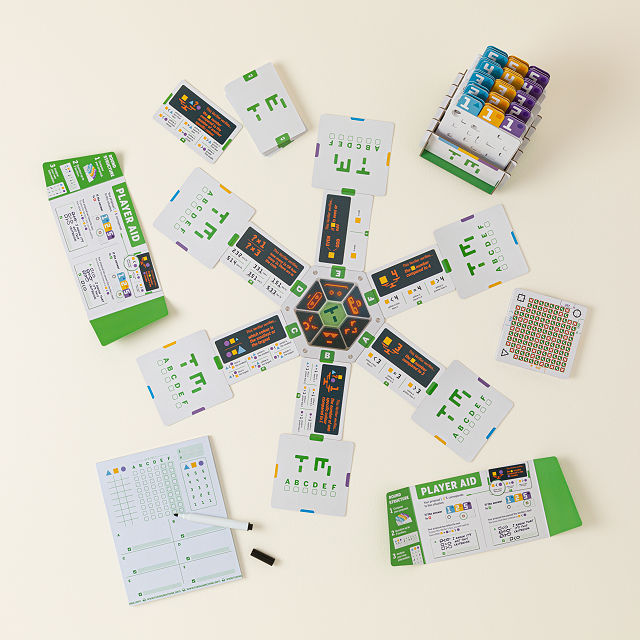
The physical game includes a board representing the tape of the Turing Machine, a set of tokens or markers symbolizing the machine’s head, and cards or sheets outlining instructions and challenges. The components are well-crafted to provide a tactile and immersive experience. If playing digitally, the game requires a device with at least moderate processing power and a screen capable of displaying detailed graphics clearly.
Core concept, gameplay style & mechanics
The gameplay simulates the operation of a Turing Machine by having players manipulate tokens on a tape-like board according to a set of rules and instructions. Players must deduce the correct sequence of operations to solve puzzles, mimicking computational processes.
Objective of the game
The goal is to complete a series of computational puzzles by correctly programming the Turing Machine’s tape and head movements. Success requires logical deduction and strategic planning to simulate the proto-computer’s behavior accurately.
Step-by-step basic gameplay loop
- Review the puzzle or challenge card outlining the problem.
- Place tokens on the tape representing the initial state.
- Apply instructions by moving the head token and modifying tape symbols according to rules.
- Analyze outcomes and adjust moves as needed to reach the solution.
- Complete the puzzle by achieving the target tape configuration.
Common mistakes
- Rushing moves without fully analyzing the puzzle can lead to errors.
- Ignoring the importance of each step’s logical consequence often causes dead ends.
- Failing to track tape changes carefully results in confusion and mistakes.
Expert tips
- Take time to understand each instruction before executing it.
- Use a systematic approach to test hypotheses and verify outcomes.
- Keep notes of your moves to backtrack effectively if needed.
Alternative games to Turing Machine
Human Resource Machine is a popular puzzle game that teaches programming concepts through office-themed challenges. It’s an excellent alternative for those who enjoy programming logic in a more narrative-driven environment. You can learn more about it here.
Robocode offers a competitive programming experience where players code virtual robots to battle in an arena. It’s a great choice for those interested in applying coding skills in a strategic, combat-based setting. Discover more about Robocode here.
Turing Machine FAQ
What age is Turing Machine suitable for?
The game is recommended for players aged 12 and older due to its logical complexity and abstract concepts.
Is prior knowledge required to play?
While prior knowledge of basic logic and algorithms is helpful, the game is designed to teach these concepts progressively, making it accessible to beginners.
Can Turing Machine be played digitally?
Yes, there are digital versions available for PC and tablets, though the primary edition is a physical board game.
How long does a typical game last?
Game sessions vary but typically last between 30 to 60 minutes depending on the puzzle complexity and player experience.
Does Turing Machine help with real-world skills?
Absolutely. It enhances critical thinking, problem-solving, and mathematical reasoning, all valuable skills in education and professional settings.
For further learning and playing
Autonauts is a game focused on automation and programming robots to perform tasks, making it a natural next step for players interested in expanding their computational thinking skills. Learn more about Autonauts here.
LeetCode is a platform offering coding challenges that help sharpen algorithmic skills. It complements the logical foundations built in the game by providing real-world programming practice. Explore LeetCode here.
To sum up
The deductive board game simulating a proto-computer is a brilliant way to engage with computational logic and develop a range of cognitive skills. It balances educational value with fun, making it perfect for anyone curious about the roots of computing and eager to boost their reasoning abilities.
Sources
Player Reviews
There are no reviews yet. Be the first one to write one.