
Turing Complete is an educational game about computer architecture and logic that helps enhance problem-solving, deductive reasoning, mathematical reasoning, planning and foresight, attention and focus. It offers a unique and engaging way to dive into the fundamentals of computing by simulating the design and operation of digital circuits. Whether you are a student, a hobbyist, or just curious about how computers work at a fundamental level, this game provides a hands-on experience that is both challenging and rewarding.
What is Turing Complete? An overview
History, origin
The game draws inspiration from the concept of a Turing machine, a fundamental model of computation introduced by Alan Turing in 1936. It was developed to teach and demonstrate the principles of computer architecture and logic in an interactive format. The game was created by Mateusz Skutnik, a developer known for crafting educational and puzzle-based games that explore technical subjects in an accessible way.
Versions and editions
Turing Complete is primarily available as a digital download for PC platforms such as Windows, macOS, and Linux. The estimated price range typically falls between $10 and $15 USD, making it an affordable educational tool. The game is available in English, which is the primary language of the interface and instructions. There are no widely known official translations into other languages.
Platform availability
The game is available on PC platforms through digital distribution services. It requires a computer capable of running basic 2D graphics and a modern operating system. No mobile or console versions are officially released.
Audience & age
The game is suitable for teenagers and adults who have an interest in computer science, logic, and programming. While no formal prerequisites are strictly required, a basic understanding of binary logic and computer fundamentals will help players progress more smoothly.
Educational Value – What skills does Turing Complete develop?
- Problem-solving: The game challenges players to design and debug digital circuits, fostering critical thinking and creative solutions to complex problems.
- Deductive reasoning: Players must logically deduce how different circuit components interact and predict outcomes, improving their ability to reason step-by-step.
- Mathematical reasoning: Understanding binary operations and Boolean algebra is essential, which strengthens mathematical logic skills.
- Planning and foresight: Designing circuits requires anticipating how changes affect the system, promoting strategic planning and careful foresight.
- Attention and focus: The detailed nature of circuit construction demands sustained concentration and meticulous attention to detail.
While prior knowledge of basic logic gates and binary numbers is helpful, the game introduces concepts gradually, making it accessible to motivated beginners.
How to play Turing Complete?
What does it look like?
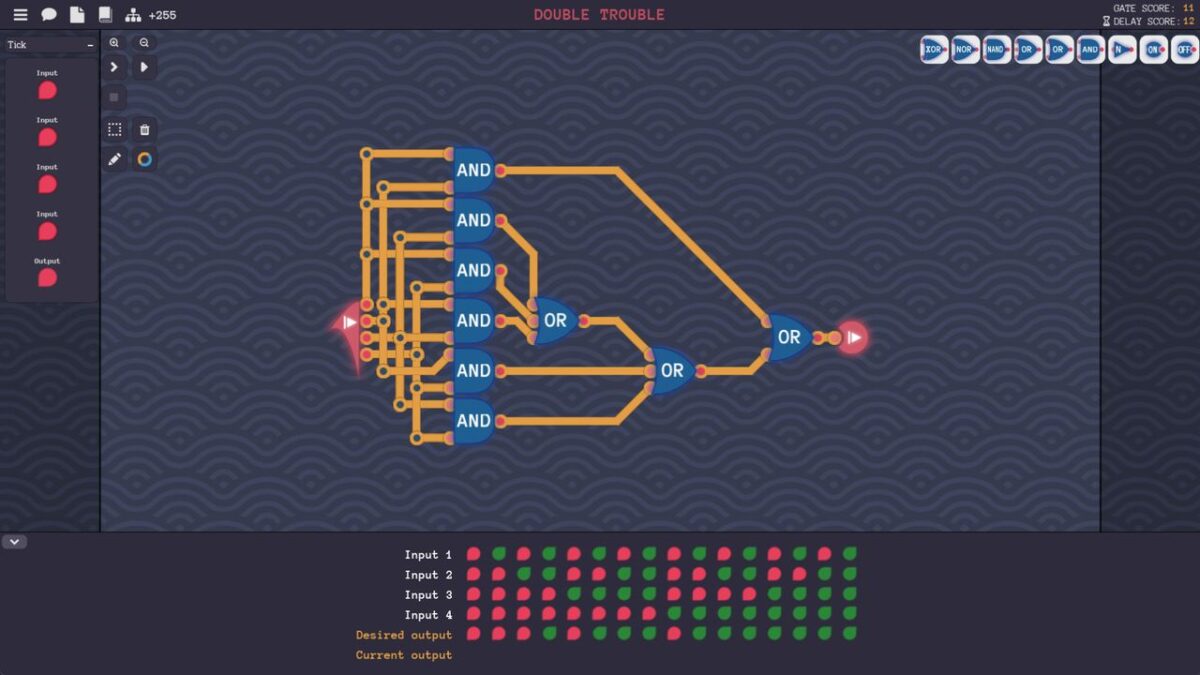
The game features a clean, minimalist 2D interface where players interact with circuit components such as logic gates, wires, and memory elements. Upon purchase, players receive a digital copy of the game that runs on PC. The technical requirements are modest: a computer with a standard processor, 2GB of RAM, and basic graphics support is sufficient.
Core concept, gameplay style & mechanics
The gameplay revolves around building and testing digital circuits to solve puzzles. Players place components on a grid, connect them with wires, and configure their behavior to achieve specific outputs. The game simulates real logic gate behavior, including AND, OR, NOT, NAND, NOR, XOR, and memory elements, providing an authentic experience.
Objective of the game
The main goal is to complete a series of puzzles by designing circuits that perform specified computational tasks. These tasks range from simple logic operations to more complex functions like arithmetic calculations and memory storage.
Step-by-step basic gameplay loop
- Analyze the puzzle requirements and understand the desired circuit output.
- Place logic gates and components on the workspace.
- Connect components with wires to form a functioning circuit.
- Test the circuit by running inputs and observing outputs.
- Debug and refine the design until the puzzle conditions are met.
Common mistakes
- Incorrect wiring causing unintended feedback loops.
- Misunderstanding the function of certain gates leading to logic errors.
- Overcomplicating designs instead of finding simpler solutions.
- Neglecting to test intermediate steps, making debugging harder.
Expert tips
- Start with small sub-circuits and test them independently before integrating.
- Use comments or notes within the game to keep track of your design logic.
- Learn and apply Boolean algebra principles to optimize circuits.
- Be patient and iterative; complex puzzles often require multiple attempts.
Alternative games to Turing Complete
Autonauts is a charming automation and programming game where players teach robots to perform tasks, focusing on crafting and resource management. It offers a broader gameplay experience but shares the educational aspect of logic and programming. You can learn more about it here.
NandGame is a puzzle game that teaches digital logic by challenging players to build circuits using NAND gates exclusively. It is a more focused and minimalist alternative that emphasizes the foundations of logic gate design. Discover more about NandGame here.
Turing Complete FAQ
What is the main educational purpose of Turing Complete?
The game aims to teach players the fundamentals of digital logic and computer architecture by having them design and test circuits that simulate computational processes.
Do I need prior knowledge to play?
While helpful, prior knowledge of basic logic gates and binary numbers is not required. The game introduces concepts gradually, making it accessible to beginners.
On which platforms can I play the game?
The game is available on PC platforms including Windows, macOS, and Linux via digital download.
How complex are the puzzles in the game?
Puzzles range from simple logic gate arrangements to advanced circuit designs involving memory and arithmetic, catering to various skill levels.
Are there alternatives to Turing Complete?
Yes, games like Autonauts and NandGame offer alternative approaches to learning programming and logic through gameplay.
For further learning and playing
Shenzhen I/O is a programming puzzle game where players design and code circuits for fictional electronics projects. It builds on the concepts introduced in Turing Complete by adding assembly language programming and real-world inspired tasks. It is a natural next step for players interested in deepening their understanding of computer engineering. More details can be found here.
TIS-100 is another programming puzzle game focused on assembly language coding and debugging in a fictional computer system. It complements Turing Complete by emphasizing low-level programming skills and logical thinking. Learn more about TIS-100 here.
To sum up
Turing Complete is a thoughtfully designed educational game that teaches the principles of computer architecture and logic through engaging puzzle-solving. It effectively develops critical cognitive skills such as problem-solving, deductive reasoning, and mathematical reasoning, making it a valuable tool for anyone interested in the inner workings of computers.
To play Turing Complete
PC: https://store.steampowered.com/app/1444480/Turing_Complete/
Sources
Player Reviews
There are no reviews yet. Be the first one to write one.