
Shenzhen I/O is the electronics engineering and assembly programming game that helps enhance problem-solving, planning and foresight, deductive reasoning, mathematical reasoning, and attention and focus. This unique game invites players into the world of circuit design and low-level programming, offering a challenging yet rewarding experience that sharpens critical thinking and technical skills.
What is Shenzhen I/O? An overview
History, origin
Developed by Zachtronics, a studio renowned for creating intellectually stimulating puzzle games, Shenzhen I/O was released in 2016. The game draws inspiration from real-world electronics engineering and assembly programming, immersing players in the role of an electronics engineer working in Shenzhen, China’s high-tech manufacturing hub.
Versions and editions
The game is primarily available as a digital download, with a price range typically between $15 and $20 USD, depending on sales and platforms. Shenzhen I/O is available in English, with community support for other languages through mods and fan translations, but no official multi-language editions exist.
Platform availability
Shenzhen I/O can be played on Windows, macOS, and Linux platforms. It is available on popular digital distribution platforms such as Steam and GOG.com, ensuring accessibility for most PC users.
Audience & age
The game is best suited for players aged 13 and above due to its complex programming and engineering concepts. It appeals to enthusiasts of puzzle games, electronics, and programming, as well as students and professionals looking to sharpen their technical skills in a fun and interactive way.
Educational Value – What skills does Shenzhen I/O develop?
- Problem-solving: The game challenges players to design circuits and write assembly code to meet specific functional requirements, encouraging creative and logical problem-solving.
- Planning and foresight: Players must plan their circuit layouts and code sequences carefully to optimize space and efficiency, developing foresight and strategic thinking.
- Deductive reasoning: Debugging and refining designs require players to analyze outputs and deduce the underlying issues, strengthening deductive reasoning skills.
- Mathematical reasoning: The game involves understanding binary operations, logic gates, and arithmetic, promoting mathematical thinking.
- Attention and focus: Precision is key when assembling circuits and programming; players must maintain high levels of concentration to succeed.
While no formal prior knowledge is strictly required, familiarity with basic programming concepts and electronics principles can enhance the gameplay experience and reduce the learning curve.
How to play Shenzhen I/O?
What does it look like?
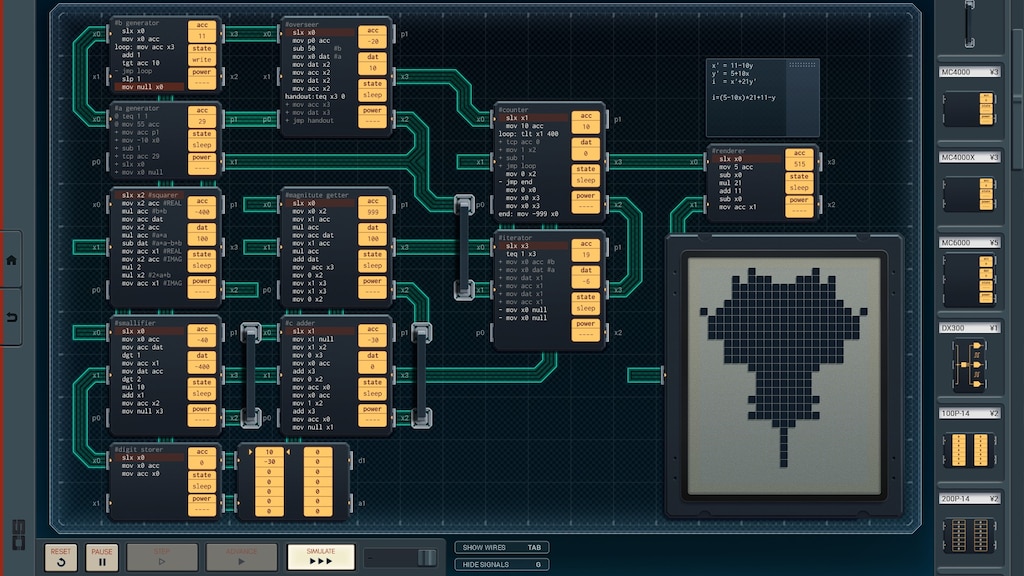
The game is played digitally and features a clean, retro-inspired interface that simulates an electronics workbench. Upon purchase, players receive access to the full digital game, which includes a code editor, circuit design tools, and a manual filled with in-game lore and technical specifications. The game runs smoothly on most modern PCs and laptops, requiring minimal hardware resources.
Core concept, gameplay style & mechanics
The gameplay revolves around designing electronic circuits using a variety of components and programming them in a simplified assembly language. Players receive design briefs with specific goals and constraints, and they must create functional solutions within these limits. The style is a blend of puzzle-solving and simulation, requiring both creativity and technical precision.
Objective of the game
The main objective is to complete a series of increasingly complex engineering puzzles by designing circuits and writing code that meet the given specifications. Success is measured by efficiency, correctness, and adherence to constraints such as component count and power consumption.
Step-by-step basic gameplay loop
- Read the design brief and understand the requirements.
- Plan the circuit layout and select appropriate components.
- Write assembly code to control the circuit’s behavior.
- Simulate and test the design to verify functionality.
- Debug and optimize the design as needed.
- Submit the solution and move on to the next challenge.
Common mistakes
- Underestimating the complexity of the assembly code required.
- Poor circuit layout leading to inefficient designs.
- Failing to thoroughly test and debug before submission.
- Ignoring power and component constraints, resulting in invalid solutions.
Expert tips
- Start with simple designs and gradually incorporate complexity.
- Use comments in your code to keep track of logic and improve readability.
- Regularly test small parts of your circuit to isolate issues early.
- Experiment with different approaches to optimize efficiency.
Alternative games to Shenzhen I/O
Screeps is a massively multiplayer online game where players program AI-controlled units in JavaScript to compete and collaborate in a persistent world. It offers a real-time programming challenge and is a great alternative for those interested in coding and strategy.
Learn more about Screeps here.
TIS-100 is another programming puzzle game by Zachtronics that focuses on assembly language programming and debugging. It shares a similar retro aesthetic and challenging gameplay style, making it a strong alternative for fans of Shenzhen I/O.
Discover TIS-100 here.
Shenzhen I/O FAQ
What platforms can I play Shenzhen I/O on?
The game is available on Windows, macOS, and Linux through digital distribution platforms like Steam and GOG.com.
Do I need prior programming knowledge to play?
While not required, having basic knowledge of programming and electronics will help you understand the game mechanics and reduce the learning curve.
Is Shenzhen I/O suitable for beginners?
The game can be challenging for beginners but includes tutorials and a supportive community to help new players learn the basics.
Can Shenzhen I/O improve my real-world skills?
Yes, it enhances skills such as problem-solving, planning, deductive reasoning, and mathematical reasoning that are valuable in electronics and programming fields.
How complex are the puzzles in Shenzhen I/O?
The puzzles range from simple introductory tasks to highly complex challenges requiring advanced circuit design and programming skills.
For further learning and playing
Google DeepMind Lab is an AI research platform offering a 3D learning environment to develop and test AI agents. It complements Shenzhen I/O by expanding the focus from electronics programming to artificial intelligence and machine learning challenges.
Explore Google DeepMind Lab here.
Linux Survival is an interactive tutorial game that teaches Linux command-line skills. It is a natural progression for players who want to deepen their programming and system administration knowledge after mastering Shenzhen I/O.
Try Linux Survival here.
To sum up
Shenzhen I/O is a captivating electronics engineering and assembly programming game that develops critical cognitive skills while providing an engaging puzzle-solving experience. Its unique blend of circuit design and low-level coding makes it a standout title for players interested in technology and programming.
Sources
Player Reviews
There are no reviews yet. Be the first one to write one.