
Scrabble
is one of the most recognizable word games ever made, and it still earns its place on family tables, classroom shelves, and mobile screens. It challenges players to build words from letter tiles, score points with smart placement, and make the most of premium squares. As the word construction board game that helps enhance Vocabulary expansion,Reading comprehension,Strategic thinking,Pattern recognition,Decision-making, it blends language practice with satisfying competition.
Even though the rules are simple enough to learn in one sitting, the game has real depth. Players need to balance short-term scoring with long-term board control, and that is part of why it remains so popular. In fact, its mix of language and strategy is what keeps beginners and experienced players equally engaged.
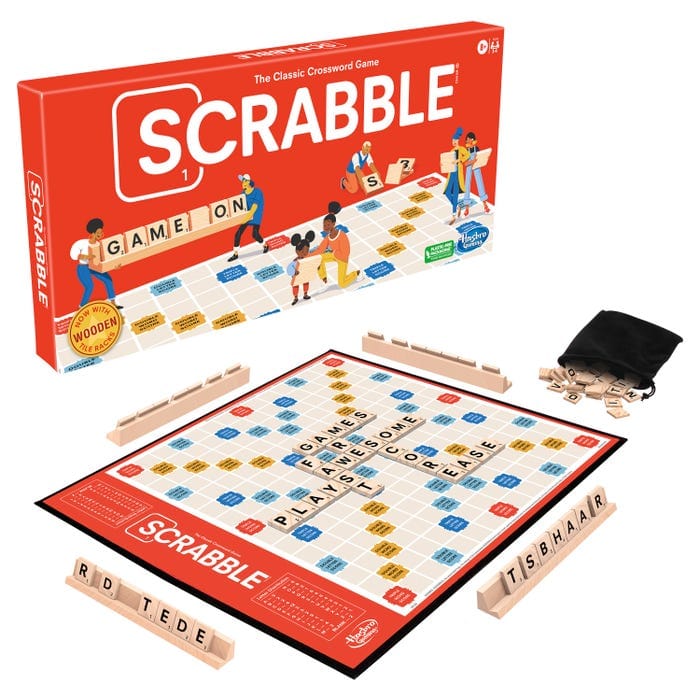
What is Scrabble? An overview
Scrabble is a multiplayer word board game in which players use lettered tiles to create interlocking words on a grid board. According to Hasbro and Mattel, standard play gives each player seven tiles, and points are awarded based on letter values and bonus squares on the board. The official objective is to finish with the highest score.
The game is typically played by 2 to 4 players. However, various digital versions and house rules can expand that range. Because each move builds on previous words, every turn asks players to read the board carefully and think ahead.
History, origin
Scrabble was developed from an earlier word game created by American architect Alfred Mosher Butts during the Great Depression. Encyclopaedia Britannica and the Scrabble brand history note that Butts first designed a game called Lexiko, later revised as Criss-Cross Words. Entrepreneur James Brunot helped refine and publish the game, and the name Scrabble was trademarked in 1948.
Its popularity rose sharply in the 1950s. Since then, it has become an international classic, with organized tournaments, official dictionaries, and multiple licensed editions. Therefore, it stands as both a mass-market board game and a serious competitive pastime.
Versions and editions
Today, the game is sold in several physical editions, including classic sets, deluxe editions with rotating boards, travel versions, and oversized luxury versions from specialty manufacturers. Based on major retailers and publisher listings, standard sets are commonly priced at about $15 to $25, while deluxe editions often range from $30 to $60 or more.
It is also available in many languages. Mattel and Hasbro have released or licensed editions in languages such as English, French, Spanish, German, Italian, and others, with tile distributions adapted to each language. As a result, the core experience stays familiar while reflecting different vocabularies and spelling patterns.
Platform availability
Scrabble can be played physically as a tabletop board game and digitally on mobile devices through official licensed apps. The main current official digital option is Scrabble GO, published for Android and iOS. These versions require a compatible smartphone or tablet, an internet connection for most features, and enough storage space to install the app through Google Play or the Apple App Store.
Official availability can vary by region, and older web or PC releases are not always actively supported. Therefore, it is best to rely on the current official publisher pages or major app stores. Physical play, of course, only requires the boxed set and enough table space.
Audience & age
Most standard editions list the game for ages 8 and up. That recommendation fits the reading and spelling demands, although younger players can still enjoy it with adult help or simplified rules. It works well for families, teens, adults, classroom enrichment, and players who enjoy thoughtful, turn-based competition.
Because luck and skill both matter, it can welcome newcomers without losing depth for experienced players. In competitive settings, players often use official word lists and stricter timing rules. Even then, the core idea remains accessible.
Educational Value – What skills does Scrabble develop?
The word construction board game that helps enhance Vocabulary expansion,Reading comprehension,Strategic thinking,Pattern recognition,Decision-making
does more than entertain. It asks players to recall words, evaluate the board, and choose between many possible moves. Prior knowledge is modest: players should know the alphabet, basic spelling, and how to read simple words in the language being used.
- Vocabulary expansion: Players regularly encounter new words, unusual spellings, and useful prefixes or suffixes. Over time, this can broaden active and passive vocabulary.
- Reading comprehension: To make legal plays, players must read existing words and understand how new tiles connect to them. This encourages close attention to word structure and meaning.
- Strategic thinking: High scores depend on more than knowing words. Players must manage their racks, control premium squares, and consider what opportunities they leave for others.
- Pattern recognition: Successful players start noticing common letter combinations, hooks, stems, and board patterns. Then they can find playable words faster and with more confidence.
- Decision-making: Every turn involves trade-offs. A player may choose between a safe score now, a stronger setup for later, or exchanging tiles to improve future options.
How to play Scrabble?
What does it look like?
A standard boxed set includes a 15-by-15 game board, 100 letter tiles, four tile racks, and usually a tile bag. The board contains premium spaces such as double letter, triple letter, double word, and triple word squares. Each tile shows a letter and its point value, while two blank tiles can stand for any letter.
Core concept, gameplay style & mechanics
The core mechanic is tile placement to form connected words, crossword-style. Players draw tiles at random, make a word on the board, score based on tile values and premium spaces, and refill their racks. However, because the board state changes every turn, planning matters as much as spelling.
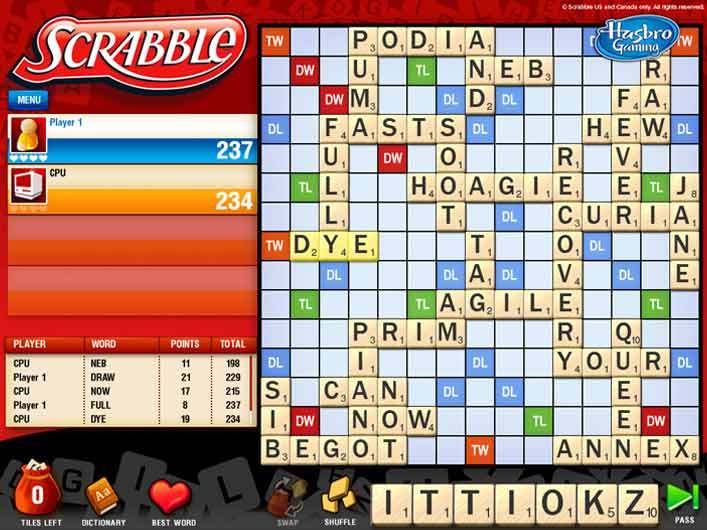
Words must follow the accepted dictionary for the edition being played, and all newly formed letter sequences must also be valid words. Therefore, placement accuracy is essential. This is what gives the game its puzzle-like tension.
Objective of the game
The goal is to finish with more points than the other players. Points come from the letters used, bonus squares, and a 50-point bonus for using all seven tiles in one turn, often called a bingo. At the end, unplayed tiles reduce a player’s score.
Step-by-step basic gameplay loop
- Each player draws seven tiles.
- One player places the opening word so it covers the center square.
- The next player adds tiles to form a new word connected to the existing layout.
- Score the play using letter values and premium squares.
- Draw replacement tiles back up to seven.
- Continue until tiles run out and no more plays are possible, or players pass repeatedly under the rules being used.
Common mistakes
New players often focus only on long words, even though short plays can score better when they hit premium squares. Another frequent mistake is leaving a triple word opening for an opponent. In addition, some players forget to check all cross-words created by their move.
Tile balance matters too. Holding too many vowels or too many consonants can stall future turns. Therefore, exchanging weak racks at the right time can be smarter than forcing a low-value play.
Expert tips
- Use short words well: Two-letter and three-letter words are powerful for tight board spots.
- Protect premium squares: A medium score that blocks a bonus can be better than a flashy play.
- Keep flexible letters: Common letters and useful combinations like ER, ING, or ED improve future options.
- Watch the rack: Good leave management is a real skill in strong play.
- Study word hooks: Adding an S, D, or R to existing words can open efficient scoring plays.
Alternative games to Scrabble
Boggle
is a fast word-search game where players find as many words as possible from a grid of letter cubes before time runs out. It is a strong alternative if you enjoy vocabulary challenges but want less downtime and more speed. Learn more here: Boggle.
Bananagrams also uses letter tiles, but it removes the fixed board and lets each player build their own word grid in real time. That makes it more frantic and portable, while still rewarding spelling skill and pattern spotting. Learn more here: Bananagrams.
Scrabble FAQ
Is Scrabble good for learning new words?
Yes. It encourages repeated exposure to spelling patterns, uncommon words, and word families. Players often remember new words better because they used them in a meaningful game situation.
How many players can play Scrabble?
The standard board game is designed for 2 to 4 players. Digital versions may include additional online features, but the classic tabletop format is usually played within that range.
What age is Scrabble for?
Most standard editions recommend ages 8 and up. Younger children can still play with support, especially if adults allow simpler words or relaxed dictionary rules.
Do you need to be good at spelling to play?
No. Strong spelling helps, but beginners can still enjoy the game by learning common short words and paying attention to board bonuses. Skill usually grows naturally with play.
Is there an official Scrabble app?
Yes. Official licensed mobile versions are available, including Scrabble GO on Android and iOS. Availability may differ by country and device compatibility.
For further learning and playing
Codenames
is a word association game that develops clue-giving, verbal flexibility, and semantic connections. It is a coherent next step because it builds on language confidence while shifting the focus from spelling to meaning and inference. Explore it here: Codenames.
Crossword Puzzles are another excellent continuation because they reward vocabulary recall, reading precision, and pattern recognition. If you enjoy fitting letters into limited spaces and thinking through clues, they feel like a natural extension of Scrabble habits. Explore them here: Crossword Puzzles.
To sum up
Scrabble remains a smart, replayable classic because it mixes language, tactics, and just enough unpredictability. As the word construction board game that helps enhance Vocabulary expansion,Reading comprehension,Strategic thinking,Pattern recognition,Decision-making, it offers lasting value for families, students, and serious word lovers alike.
To play Scrabble
Smartphone: Android, iPhone/iPad
Sources of information
Encyclopaedia Britannica – ScrabbleHasbro – Scrabble board game product pageGoogle Play – Scrabble GOApple App Store – Scrabble GO
Player Reviews
There are no reviews yet. Be the first one to write one.