
Algebra Tiles are a powerful visual manipulative designed for representing and solving algebraic expressions in a hands-on way. This game-like tool helps learners develop essential skills such as mathematical reasoning, pattern recognition, and problem-solving. By converting abstract algebra concepts into tangible objects, it makes learning more accessible and engaging.
What is Algebra Tiles? An overview
History, origin
Algebra Tiles originated as an educational tool developed to help students visualize and understand algebraic concepts. They emerged from the broader category of manipulative materials used in math education, gaining popularity in classrooms since the late 20th century. These tiles provide a bridge between concrete and abstract thinking, allowing learners to physically manipulate pieces that represent variables and constants.
Versions and editions
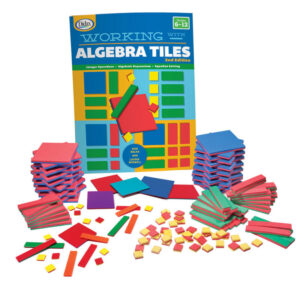
Algebra Tiles come in various forms, including physical kits and digital apps. Physical kits typically consist of plastic or foam tiles representing units, variables, and their squares. Prices for physical sets usually range from $10 to $30 depending on quality and included components. Digital versions may be free or cost a small fee, often available in multiple languages including English, Spanish, and French, reflecting their global educational use.
Platform availability
The game is available as a physical manipulative kit for classroom and home use. Additionally, digital versions exist as web-based applications or mobile apps compatible with iOS and Android devices, making it accessible on tablets and smartphones.
Audience & age
Algebra Tiles are primarily aimed at middle school and early high school students, typically ages 11 to 16. However, they can also be useful for younger students beginning algebra concepts or adults seeking to reinforce foundational algebra skills.
Educational Value – What skills does Algebra Tiles develop?
- Mathematical reasoning: The game encourages learners to think logically about how algebraic expressions are constructed and manipulated. By physically grouping and rearranging tiles, players develop a deeper understanding of operations like addition, subtraction, and factoring.
- Pattern recognition: Players identify and create patterns in algebraic expressions, such as recognizing like terms or factoring quadratics. This visual approach helps solidify these abstract concepts.
- Problem-solving: The manipulative nature of the game allows learners to experiment with solving equations and simplifying expressions step-by-step, fostering critical thinking and perseverance.
Prior knowledge of basic arithmetic and an introduction to variables is helpful before using the game to maximize learning benefits.
How to play Algebra Tiles?
What does it look like?
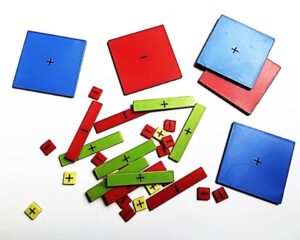
The physical game includes sets of square and rectangular tiles. Typically, small squares represent constants (like +1 or -1), rectangles represent variables (like +x or -x), and large squares represent squared variables (like +x² or -x²). Each tile’s color usually indicates its sign (positive or negative). Digital versions replicate these tiles on screen, allowing drag-and-drop interaction. Technical requirements for digital play include a modern web browser or a smartphone/tablet with iOS or Android OS.
Core concept, gameplay style & mechanics
The game is centered around manipulating tiles to model algebraic expressions visually. Players add, subtract, and rearrange tiles to simplify expressions, solve equations, or factor polynomials. The tactile or interactive nature helps learners internalize algebraic principles more intuitively than symbolic manipulation alone.
Objective of the game
The main goal is to understand and solve algebraic expressions and equations by using the tiles to represent terms physically. Through this, learners develop a conceptual grasp of algebraic operations and relationships.
Step-by-step basic gameplay loop
- Start with an algebraic expression to model.
- Use tiles to represent each term visually.
- Manipulate tiles by combining like terms or removing zero pairs (positive and negative tiles).
- Rearrange tiles to simplify the expression or solve for a variable.
- Repeat these steps to practice various algebra problems.
Common mistakes
- Confusing the signs of tiles, leading to incorrect simplification.
- Failing to combine like terms properly.
- Misinterpreting the representation of squared variables.
Expert tips
- Always double-check tile signs before combining.
- Use color coding consistently to avoid confusion.
- Practice with simple expressions before moving to more complex equations.
- In digital versions, take advantage of undo and reset features for experimentation.
Alternative games to Algebra Tiles
Two excellent alternatives to this game are the Balance Math Kit and SolveMe Mobiles. The Balance Math Kit also uses visual and physical components to teach algebraic balance and equation solving, making it highly complementary. SolveMe Mobiles offers a puzzle-based approach to algebra, encouraging logical thinking and problem-solving in a fun format. Both provide engaging alternatives for learners who enjoy hands-on or game-based learning.
Algebra Tiles FAQ
What are Algebra Tiles used for?
Algebra Tiles are used as visual manipulatives to help learners understand and solve algebraic expressions and equations by representing terms physically.
Who can benefit from using Algebra Tiles?
Students learning algebra, especially middle and high school learners, as well as educators and tutors looking for effective teaching tools, can benefit from using Algebra Tiles.
Are Algebra Tiles available in digital format?
Yes, there are digital versions of Algebra Tiles available as web applications and mobile apps compatible with iOS and Android devices.
Do Algebra Tiles require prior knowledge to use?
Basic understanding of arithmetic and an introduction to variables help maximize the effectiveness of Algebra Tiles, though beginners can also learn through guided practice.
How do Algebra Tiles improve math skills?
They improve skills by providing a hands-on way to explore algebra concepts, enhancing mathematical reasoning, pattern recognition, and problem-solving abilities.
For further learning and playing
After mastering Algebra Tiles, learners can progress to games like DragonBox Algebra 12+ and Hands-On Equations. DragonBox Algebra 12+ offers a more advanced, gamified approach to algebra concepts suitable for older students, building on the foundational skills developed with Algebra Tiles. Hands-On Equations provides a structured method for solving linear equations with a focus on balance and logic, making it a natural next step for learners seeking deeper algebraic understanding.
To sum up
Algebra Tiles are an effective educational tool that transforms abstract algebra into a visual and tactile experience. They support key skills like mathematical reasoning, pattern recognition, and problem-solving, making algebra more approachable and enjoyable.
Sources
National Council of Teachers of Mathematics (NCTM)
Math Playground
Khan Academy Algebra Resources
Player Reviews
There are no reviews yet. Be the first one to write one.