
Codenames is a captivating word-based team deduction game that has taken the board gaming world by storm. It’s a fantastic way to sharpen your Communication, Deductive reasoning, Teamwork and collaboration, Pattern recognition, and Decision-making skills—all while having a blast with friends or family. Whether you’re a casual gamer or a word enthusiast, this game offers a perfect blend of challenge and fun.

What is Codenames? An overview
History, Origin
Created by Vlaada Chvátil and published by Czech Games Edition in 2015, the game quickly became a bestseller thanks to its innovative gameplay and social interaction. It has won multiple awards, including the prestigious Spiel des Jahres (Game of the Year) in 2016. The concept revolves around teams competing to uncover secret agents based on one-word clues, making it a fresh take on classic word and deduction games.
Versions and Editions
The original game is available in a physical box set, typically priced between $15 and $30 depending on the retailer and edition. There are also special editions such as “Codenames: Pictures,” which uses images instead of words, and “Codenames: Duet,” designed specifically for two players. The game is available in over 30 languages, making it accessible worldwide.
Platform availability
While primarily a physical board game, there are official digital versions available on platforms like iOS, Android, and Steam, allowing players to enjoy the game remotely. The digital versions maintain the core gameplay but add conveniences like online matchmaking.
Level of complexity
The game is easy to learn but offers deep strategic layers. Beginners can quickly grasp the rules, but mastering clue-giving and deduction requires practice. The complexity lies in interpreting clues and managing team communication effectively.
Audience & Age
Codenames is suitable for players aged 14 and up, making it perfect for teenagers and adults. It’s ideal for groups of four or more, though some editions cater to smaller groups. The game’s social and intellectual nature appeals to families, casual gamers, and serious board game enthusiasts alike.
Educational Value – What skills does Codenames develop?
- Communication: Players must carefully craft and interpret one-word clues, promoting clear and creative expression.
- Deductive reasoning: Guessers analyze clues and eliminate possibilities, honing logical thinking.
- Teamwork and collaboration: Success depends on shared understanding and cooperation within teams.
- Pattern recognition: Players identify connections between seemingly unrelated words, sharpening cognitive flexibility.
- Decision-making: Quick, strategic choices are necessary to avoid pitfalls and secure victory.
Prior knowledge required is minimal; basic vocabulary and the ability to think abstractly are enough to enjoy and benefit from the game.
How to play Codenames?
What does it look like?
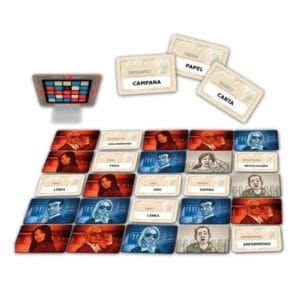
The physical game includes 200 double-sided cards featuring 400 unique words, a key card indicating the location of agents, an hourglass timer, and a set of red and blue agent cards. The components are compact and durable, designed for repeated play. The digital versions require a smartphone, tablet, or PC with internet access to connect with other players.
Core concept, gameplay style & mechanics
Players split into two teams, each with a Spymaster who knows the secret identities of agents on the board. The Spymaster gives one-word clues paired with a number indicating how many words relate to that clue. Teammates then guess which words the clue points to, trying to avoid words belonging to the opposing team or the deadly assassin word.
Objective of the game
The goal is to be the first team to correctly identify all their agents based on the Spymaster’s clues without selecting the assassin word, which causes an instant loss.
Initial Setup and learning curve
Setup is straightforward: lay out 25 word cards in a 5×5 grid, choose Spymasters, and reveal the key card. The learning curve is gentle, with players quickly picking up the rules after one or two rounds.
Step-by-step Basic Gameplay Loop
- Spymaster gives a one-word clue and a number.
- Team members discuss and guess words on the grid.
- Each guess is checked against the key card to confirm if it’s correct.
- Turn ends when the team guesses wrong, passes, or reaches the clue’s number.
- Teams alternate turns until one identifies all agents or hits the assassin.
Common mistakes
- Giving clues that are too vague or too obvious.
- Guessing without sufficient discussion or rushing decisions.
- Ignoring the risk of the assassin word.
- Failing to consider multiple meanings of clues.
Expert tips
- Think abstractly and creatively when giving clues.
- Pay attention to your team’s knowledge and associations.
- Use the number wisely to guide the number of guesses.
- Practice active listening and collaboration during guessing.
Alternative games to Codenames
If you enjoy this word-based team deduction game, you might also like Decrypto and Just One. Decrypto challenges teams to transmit secret codes through clever word clues, promoting similar skills in communication and deduction. Just One is a cooperative party game where players give one-word clues to help a teammate guess a mystery word, emphasizing creativity and teamwork.
FAQ
What is the recommended number of players for Codenames?
The game is best played with 4 to 8 players, divided into two teams. However, it can accommodate larger groups by adjusting team sizes.
How long does a typical game last?
A standard game usually takes about 15 to 30 minutes, making it a great choice for quick, engaging sessions.
Can children play Codenames?
While the recommended age is 14 and up, younger children can play with adult assistance, especially if they have a good vocabulary and understanding of abstract clues.
Is prior knowledge required to play?
No specialized knowledge is needed. A basic vocabulary and willingness to think creatively are sufficient to enjoy the game.
Are there digital versions of the game?
Yes, official digital versions are available on mobile devices and PC, allowing online multiplayer experiences.
What makes Codenames different from other word games?
Its unique combination of team-based deduction, one-word clue giving, and risk management sets it apart, creating a dynamic social experience.
For Further Learning and Playing
Spyfall is a social deduction game where players ask questions to identify the spy among them. It builds on the communication and deduction skills developed in Codenames, emphasizing bluffing and quick thinking. You can find more about it here.
Concept challenges players to guess words and phrases using a board filled with icons, encouraging abstract thinking and pattern recognition. It complements the skills from Codenames by focusing more on visual clues and collaborative reasoning. Learn more here.
To sum up
This word-based team deduction game is a brilliant way to engage your mind and connect with others. It’s accessible, educational, and endlessly replayable, making it a must-have for any game collection.
Sources:
Player Reviews
There are no reviews yet. Be the first one to write one.