
Scrabble is the classic word construction board game that helps enhance vocabulary expansion, reading comprehension, strategic thinking, pattern recognition, and decision-making. Loved by millions worldwide, it combines fun with learning in a way few games do. Whether you’re a casual player or a word enthusiast, this game offers a perfect blend of challenge and entertainment.
What is Scrabble? An overview
History, Origin
Scrabble was invented in 1938 by Alfred Mosher Butts, an architect who combined elements of anagrams and crossword puzzles to create a new word game. Initially called “Lexiko” and later “Criss-Cross Words,” it was renamed Scrabble in the early 1940s. The game gained popularity in the 1950s and has since become a household staple worldwide.
Versions and Editions
Over the years, Scrabble has seen numerous editions, including themed versions, travel sets, and deluxe editions. Prices vary widely, typically ranging from $15 to $50 depending on the edition and retailer. The game is available in more than 30 languages, including English, Spanish, French, German, Italian, and many others, making it accessible to players globally.
Platform availability
Besides the traditional physical board game, Scrabble is available on multiple digital platforms. You can play it on smartphones, tablets, and computers via official apps and online versions. These digital adaptations often include single-player modes, multiplayer options, and various difficulty levels.
Level of complexity
The game is easy to learn but challenging to master. Basic rules are straightforward, making it suitable for beginners, but strategic depth and vocabulary knowledge add complexity for advanced players.
Audience & Age
Scrabble is designed for players aged 8 and up, making it a great family game. It appeals to a wide audience, from children developing language skills to adults who enjoy word challenges and strategic gameplay.
Educational Value – What skills does Scrabble develop?
- Vocabulary expansion: The game encourages players to learn new words and improve spelling, which naturally broadens their vocabulary over time.
- Reading comprehension: Players must recognize valid words and understand their meanings, which enhances overall reading skills.
- Strategic thinking: Beyond just forming words, players plan moves to maximize points and block opponents, honing strategic decision-making.
- Pattern recognition: Spotting letter combinations and potential word placements requires sharp pattern recognition skills.
- Decision-making: Players evaluate multiple options each turn, balancing risk and reward to optimize their score.
Prior knowledge of the alphabet and basic spelling is necessary to play, but the game itself is an excellent tool for reinforcing these fundamentals.
How to play Scrabble?
What does it look like?
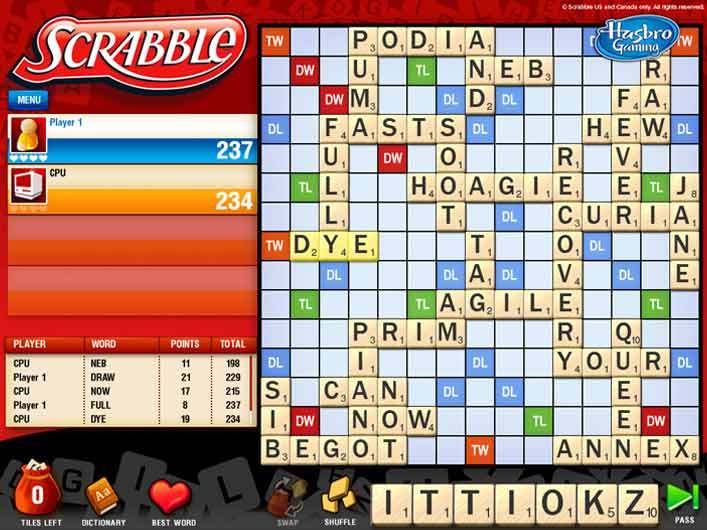
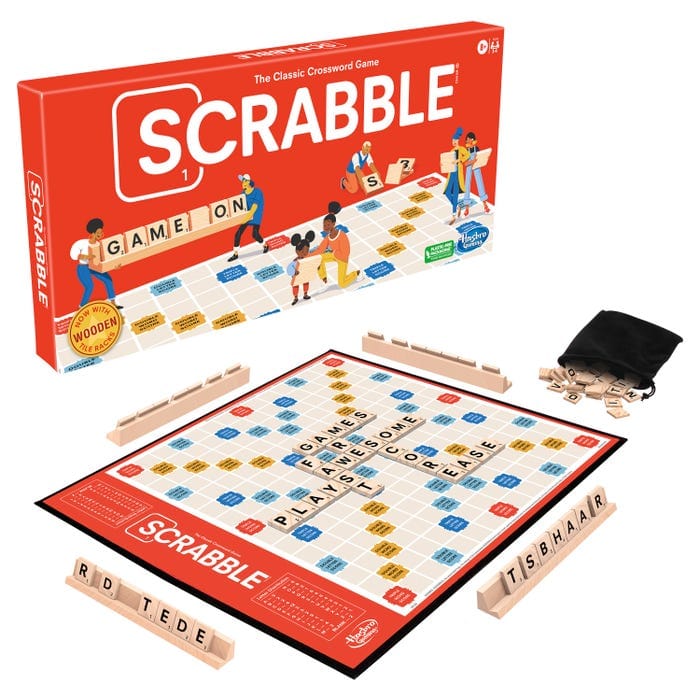
When you purchase the physical game, you receive a square game board with a 15×15 grid, 100 letter tiles, four tile racks, and a bag to draw tiles from. The board includes special premium squares that multiply letter or word scores. Digital versions require a compatible smartphone, tablet, or PC with internet access for multiplayer modes.
Core concept, gameplay style & mechanics
The core concept revolves around creating words on the board by placing letter tiles horizontally or vertically. Each letter has a point value, and the board features premium squares that boost scores. Players take turns drawing tiles and forming words, competing to earn the highest total points.
Objective of the game
The main goal is to accumulate the highest score by strategically placing words on the board. The game ends when all tiles are drawn and one player uses their last tile, or when no more valid moves are possible.
Initial Setup and learning curve
Setup is simple: each player draws seven tiles and places them on their rack. The first player forms a word covering the center square. Learning the rules takes minutes, but mastering strategy and vocabulary can take much longer, making it rewarding for players at all levels.
Step-by-step Basic Gameplay Loop
- Draw seven tiles from the bag.
- Form a valid word on the board using your tiles.
- Calculate and record your score, including any premium squares.
- Draw new tiles to replenish your rack to seven tiles.
- Pass the turn to the next player.
Common mistakes
- Playing invalid or misspelled words.
- Ignoring premium squares and missing high-scoring opportunities.
- Failing to block opponents’ potential high-value moves.
- Not managing tiles efficiently, leading to poor letter distribution.
Expert tips
- Learn two-letter words and common prefixes/suffixes to increase options.
- Keep a balanced rack with vowels and consonants.
- Focus on premium squares and try to create multiple words in one turn.
- Watch opponents’ racks and anticipate their moves.
Alternative games to Scrabble
If you enjoy this word construction board game that helps enhance vocabulary expansion, reading comprehension, strategic thinking, pattern recognition, and decision-making, you might also like Boggle and Bananagrams. Both are fast-paced word games that emphasize quick thinking and vocabulary skills. Boggle challenges players to find as many words as possible from a grid of letters within a time limit, while Bananagrams is a race to build a crossword grid using letter tiles. These alternatives offer fresh twists on word-building fun.
FAQ
What is the minimum age to play Scrabble?
Scrabble is generally recommended for players aged 8 and older due to the vocabulary and reading skills required.
How many players can play Scrabble?
The game is best suited for 2 to 4 players, though some versions and house rules allow for more participants.
Can Scrabble be played online?
Yes, there are official digital versions and apps that allow players to compete online with friends or other players worldwide.
How long does a typical game last?
A standard game usually takes about 50 to 90 minutes, depending on the number of players and their familiarity with the game.
Are there tournaments for Scrabble?
Yes, there are official Scrabble tournaments held worldwide, including national and international championships.
For Further Learning and Playing
After mastering this word construction board game that helps enhance vocabulary expansion, reading comprehension, strategic thinking, pattern recognition, and decision-making, you might want to explore Codenames and Crossword Puzzles. Codenames is a team-based word game that encourages creative clue-giving and association skills, making it a natural next step for players who enjoy wordplay and strategy. Crossword puzzles, on the other hand, deepen vocabulary and general knowledge through clues and word fitting, further enhancing reading comprehension and pattern recognition.
To sum up
Scrabble remains a timeless classic that combines fun and education. It effectively develops vocabulary, reading skills, and strategic thinking through engaging gameplay. Whether played casually or competitively, it offers endless opportunities for learning and enjoyment.
Sources:
Player Reviews
There are no reviews yet. Be the first one to write one.