
Catan is one of the best-known modern board games, and for good reason. It blends resource collection, trading, and map-based expansion into a format that feels approachable at first but stays interesting over many plays. As the resource management strategy board game that helps enhance Strategic thinking, Negotiation and persuasion, Planning and foresight, Decision-making, Adaptability, it offers a smart mix of luck, tactics, and player interaction.
First published in 1995, the game helped popularize hobby board gaming far beyond dedicated enthusiasts. Even today, it remains a frequent recommendation for families, friend groups, and players ready to move beyond classic roll-and-move titles. Therefore, if you want a strategy game that is social as well as thoughtful, this one is an easy title to know.
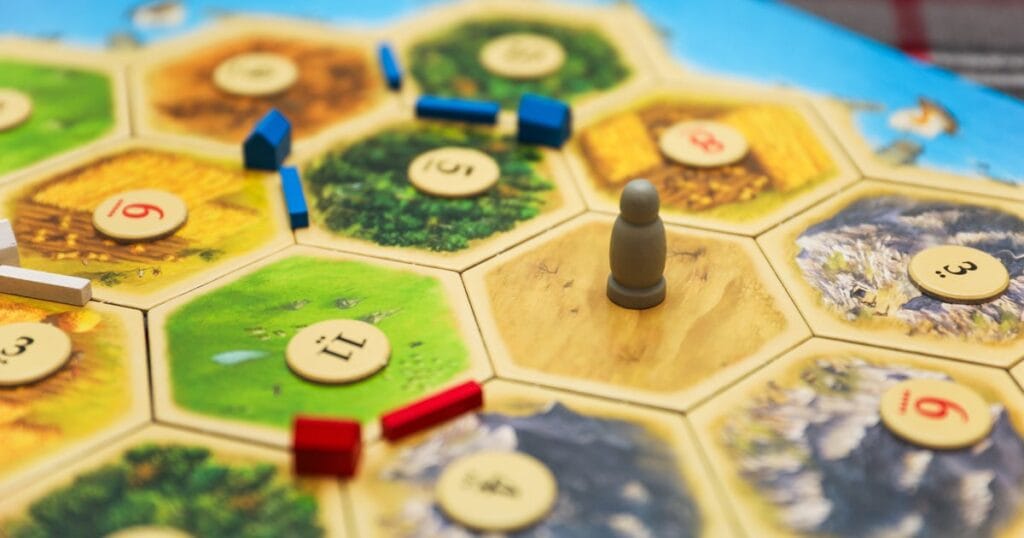
What is Catan? An overview
Catan is a multiplayer board game designed by Klaus Teuber and published by Catan Studio in English-language markets. Players settle an island made of hexagonal terrain tiles, gather resources such as brick, lumber, wool, grain, and ore, and use them to build roads, settlements, and cities. The game is usually played by 3 to 4 players, with the base game recommended for ages 10 and up.
The core experience centers on balancing probability, expansion, and trading. Because resources are produced by dice rolls tied to numbered spaces, players must plan around both opportunity and uncertainty. However, smart negotiation often matters just as much as a strong board position.
History, origin
The game was created by German designer Klaus Teuber and originally released in 1995 as Die Siedler von Catan. It won the prestigious Spiel des Jahres in 1995, helping bring Euro-style board games to a much wider audience. In fact, its success is often cited as a major milestone in modern tabletop gaming.
Over time, the branding evolved, and the title is now commonly presented simply as Catan. Official publisher information also notes that tens of millions of copies have been sold worldwide. As a result, it has become one of the most recognizable strategy board games ever published.
Versions and editions
The standard base game remains the main entry point, and it has also been supported by official expansions such as 5–6 Player Extension, Seafarers, Cities & Knights, and Traders & Barbarians. There are also themed editions and family-friendly spin-offs in the broader line. Therefore, players can keep the experience simple or expand it over time.
For price, the base tabletop edition is commonly sold in an estimated range of about $40 to $60 USD, while extensions and expansions vary. Official product pages and major retailers may differ by region, edition, and availability. The game has been published in many languages, with official Catan materials noting availability across numerous international markets, including English, German, French, Spanish, Italian, Dutch, and more.
Platform availability
Official digital versions have been available on multiple platforms. Catan Universe supports play in a web browser and on PC, Mac, iOS, and Android, although users need an account and a compatible device or browser. In addition, Catan – Console Edition is available on modern consoles, with platform store access and the usual account requirements for online features.
Requirements depend on the platform. Browser play needs a current web browser and internet connection, while mobile play requires a supported Android or iOS device. Console versions, of course, need the relevant hardware and store account.
Audience & age
The official recommended age is 10+, and that feels accurate for most groups. Younger players can learn it with help, but the trading, probability, and positioning become more rewarding as players gain confidence. Because turns are structured and the goal is clear, it works well for families, teens, and adults alike.
It is especially good for players who enjoy interaction. Unlike multiplayer solitaire strategy games, this one constantly invites deals, table talk, and tactical reactions. Even though the rules are manageable, the social layer gives it lasting depth.
Educational Value – What skills does Catan develop?
Beyond being fun, it stands out as the resource management strategy board game that helps enhance Strategic thinking, Negotiation and persuasion, Planning and foresight, Decision-making, Adaptability. Players do not need prior subject knowledge to start, only the ability to follow rules, count resources, and think a few turns ahead. However, basic comfort with turn-taking and simple probability ideas can help new players learn faster.
- Strategic thinking: Players choose where to settle, which routes to block or expand, and when to aim for longest road, cities, or development cards.
- Negotiation and persuasion: Trading is central, so players practice making offers, reading incentives, and convincing others that a deal is worth taking.
- Planning and foresight: Good play means preparing for future builds, securing resource access, and anticipating how the board may develop.
- Decision-making: Every turn asks players to prioritize limited resources, weigh risks, and choose between short-term gains and long-term goals.
- Adaptability: Dice results, blocked spaces, and shifting trade opportunities force players to adjust plans instead of following a fixed script.
How to play Catan?
What does it look like?
The physical base game includes terrain hexes, number tokens, resource cards, development cards, the robber, roads, settlements, cities, and two dice. Players build on intersections and connect locations with roads across a modular island map. Because the board setup changes from game to game, replayability is one of its biggest strengths.
Core concept, gameplay style & mechanics
The central idea is simple: gather resources and convert them into better infrastructure before your rivals do. Dice determine which terrain spaces produce resources each turn, and players whose settlements or cities touch matching numbers collect the relevant cards. Then, they build, trade, and compete for key spaces.
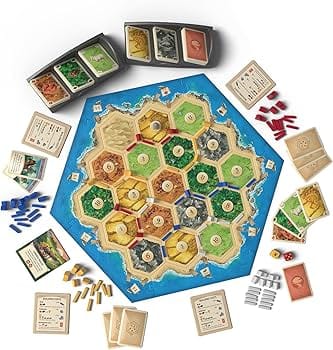
Mechanically, it combines resource management, route building, area expansion, trading, and variable setup. The robber adds disruption by blocking a tile and stealing from nearby opponents. Therefore, the game constantly mixes growth with tactical interference.
Objective of the game
The goal is to be the first player to reach 10 victory points. Points mainly come from settlements, cities, certain development cards, and special awards such as Longest Road and Largest Army. In short, efficient expansion wins the day.
Step-by-step basic gameplay loop
- Set up the island with terrain hexes and number tokens.
- Each player places starting settlements and roads.
- On a turn, roll the dice to produce resources from matching numbered tiles.
- If a 7 is rolled, the robber activates and may force discards.
- Trade with players or, if possible, with the bank or ports.
- Spend resources to build roads, settlements, cities, or buy development cards.
- Check victory points and continue until someone reaches 10.
Common mistakes
New players often focus too much on one resource type or build without a long-term road plan. Another frequent mistake is ignoring trade value and refusing fair deals that would accelerate development. Also, many beginners underestimate the importance of flexible starting placements.
It is also easy to chase every opportunity at once. However, the game rewards players who commit to a sensible path and adapt only when needed. Balanced access to strong numbers usually beats flashy but fragile openings.
Expert tips
- Value your starting settlements highly: Early placement shapes the entire game.
- Watch number probabilities: Spaces with 6 and 8 tend to produce more often than 2 or 12.
- Trade with purpose: Make deals that improve your position without obviously handing the lead to someone else.
- Use ports well: A strong port strategy can reduce dependence on table trades.
- Stay unpredictable: Switching from road expansion to city upgrades at the right time can catch opponents off guard.
Alternative games to Catan
If you enjoy this style of tabletop strategy, Ticket to Ride is a great alternative. It is less negotiation-heavy, but it offers satisfying route building, hand management, and approachable rules. Therefore, it works especially well for players who like planning networks without as much direct trading.
Carcassonne is another strong option. Instead of trading resources, players place tiles to build a shared landscape of roads, cities, and fields while deploying followers to score points. It is a good alternative because it keeps the strategic feel and replayability, yet delivers a calmer and more spatial experience.
Catan FAQ
Is Catan good for beginners?
Yes. The rules are manageable, the turn structure is clear, and new players can learn the basics in one session. At the same time, it still offers enough depth to stay interesting.
How long does a game of Catan take?
The official play time for the base game is commonly listed at about 60 minutes. However, games may run longer with new players or highly interactive groups.
How many players can play Catan?
The standard base game supports 3 to 4 players. An official extension allows play with 5 to 6 players.
Is Catan based on luck or skill?
It uses both. Dice rolls create uncertainty, but strong settlement placement, good trades, and smart planning have a major impact on results over time.
What age is Catan for?
The official age recommendation is 10 and up. Many families use that as a reliable guideline.
For further learning and playing
Power Grid is a logical next step for players who enjoy economic planning and resource timing. It increases the complexity of auctions, infrastructure growth, and long-range efficiency, making it a strong continuation for players ready for deeper strategic systems.
Brass: Birmingham is another excellent follow-up. It builds on ideas of network development, resource links, and tough economic choices, but in a much more demanding format. As a result, it suits players who love the strategic side of the resource management strategy board game that helps enhance Strategic thinking, Negotiation and persuasion, Planning and foresight, Decision-making, Adaptability and want a heavier challenge.
To sum up
Catan remains a standout modern classic because it combines accessible rules with meaningful strategy and lively player interaction. If you want the resource management strategy board game that helps enhance Strategic thinking, Negotiation and persuasion, Planning and foresight, Decision-making, Adaptability, it is still one of the strongest places to start.
To play Catan
Web browser: https://catanuniverse.com/
PC: https://store.steampowered.com/app/544730/Catan_Universe/
Smartphone: Android, iPhone/iPad, PlayStation Console Edition, Xbox Console Edition, Nintendo Switch Console Edition
Sources of information
https://www.catan.com/
https://www.catanstudio.com/
https://boardgamegeek.com/boardgame/13/catan
https://catanuniverse.com/
https://store.steampowered.com/app/544730/Catan_Universe/
https://www.nintendo.com/
https://www.xbox.com/
https://store.playstation.com/
Player Reviews
There are no reviews yet. Be the first one to write one.