
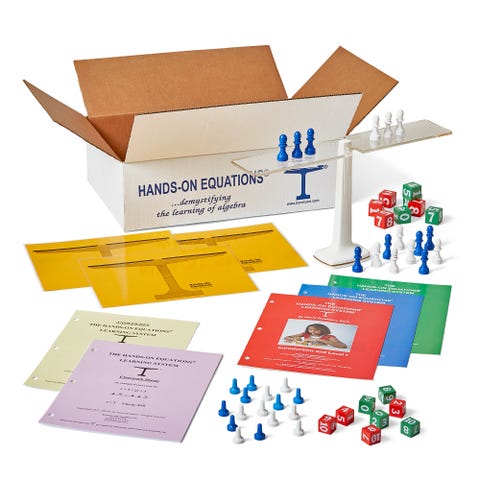
Hands-On Equations is an innovative system using pawns and cubes on a balance scale to solve linear equations. It offers a unique, tactile approach to algebra that makes abstract concepts concrete and accessible. By engaging with physical objects, players develop essential skills such as mathematical reasoning, deductive reasoning, problem-solving, and pattern recognition. This method transforms learning algebra from a daunting task into an enjoyable and rewarding experience.
What is Hands-On Equations? An overview
History, origin
Hands-On Equations was developed by Dr. Henry Borenson, an educator and mathematician dedicated to making algebra accessible for all students. The system originated in the 1990s as a response to the difficulties many learners face when first encountering algebraic concepts. Dr. Borenson’s approach uses physical models to represent variables and constants, which helps demystify the process of solving linear equations.
Versions and editions
The game is available in multiple editions tailored for various age groups, typically targeting learners from late elementary to middle school. The core product includes a set of pawns, cubes, a balance scale, and a workbook with progressively challenging problems. Prices generally range between $30 and $50, depending on the package and retailer. The system is available primarily in English, with some editions and instructional materials offered in Spanish and other languages to accommodate diverse learners.
Platform availability
Hands-On Equations is primarily a physical kit, designed for hands-on interaction in classrooms or at home. While the core experience is tactile, digital versions and supplementary apps have been developed to complement the physical system. These digital tools can be used on tablets and PCs but do not replace the original hands-on method.
Audience & age
The system is designed for students aged 8 and up, making it suitable for elementary through middle school learners. It is especially helpful for those who struggle with traditional algebra instruction or who benefit from kinesthetic learning styles. Teachers and parents also find it a valuable resource for introducing foundational algebra concepts in a friendly, approachable way.
Educational Value – What skills does Hands-On Equations develop?
The system using pawns and cubes on a balance scale to solve linear equations helps enhance several critical thinking and cognitive skills. Below are the core skills that the game nurtures:
- Mathematical reasoning: By physically manipulating the balance scale and pieces, learners see the direct relationship between equations and their solutions, improving their understanding of algebraic principles.
- Deductive reasoning: Players must deduce the value of unknowns by following logical steps, reinforcing systematic thinking and inference skills.
- Problem-solving: The game presents progressively challenging problems that encourage players to develop strategies and perseverance in finding solutions.
- Pattern recognition: Repeated exposure to equation structures and solution methods helps learners identify patterns, which supports quicker and more intuitive problem solving.
Prior knowledge required is minimal; basic arithmetic skills such as addition and subtraction suffice to begin. The game scaffolds learning so that even beginners can gradually master linear equations.
How to play Hands-On Equations?
What does it look like?
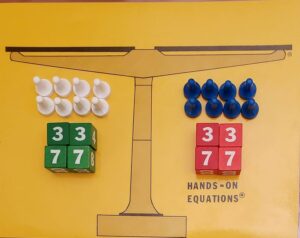
The physical kit includes a plastic balance scale, blue pawns representing variables (usually “x”), and white cubes representing constants. The balance scale visually represents both sides of an equation, and players place pawns and cubes on either side to model equations physically. The kit also comes with an instructional workbook guiding players through lessons and exercises.
Core concept, gameplay style & mechanics
Gameplay revolves around setting up linear equations on the balance scale and using logical moves to isolate the variable pawn. Players perform operations such as removing equal numbers of cubes from both sides or adding cubes to maintain balance. This hands-on manipulation embodies the algebraic principle of maintaining equality on both sides of an equation.
Objective of the game
The primary goal is to solve for the unknown variable by simplifying the equation on the balance scale until the value of the pawn is determined. This visual and tactile process helps solidify the conceptual understanding of algebraic solving.
Step-by-step basic gameplay loop
- Set up an equation on the balance scale using pawns and cubes.
- Identify equal elements on both sides that can be removed or added.
- Perform operations to simplify the equation while keeping the scale balanced.
- Continue until the variable pawn is isolated and its value is clear.
- Verify the solution by checking the balance of the scale.
Common mistakes
- Removing unequal numbers of cubes from each side, which breaks the balance.
- Misunderstanding the role of the pawns as variables rather than constants.
- Skipping steps and rushing, leading to incorrect solutions.
Expert tips
- Always think of the balance scale as a real scale that must stay balanced after every move.
- Use the workbook’s step-by-step instructions to build confidence before attempting more complex problems.
- Encourage verbalizing each step to reinforce understanding and reasoning.
Alternative games to Hands-On Equations
For those interested in similar educational experiences, DragonBox Algebra 12+ is an excellent digital alternative. It gamifies algebra concepts through puzzles and interactive challenges designed for slightly older learners. DragonBox uses visual representations and intuitive gameplay to teach algebraic principles, making it a great complement or follow-up to Hands-On Equations.
Hands-On Equations FAQ
What age is Hands-On Equations suitable for?
It is designed for children aged 8 and up, making it ideal for elementary and middle school students beginning to learn algebra.
Does Hands-On Equations require prior algebra knowledge?
No, the game is designed to introduce algebra concepts from the ground up, requiring only basic arithmetic skills.
Is Hands-On Equations available in digital format?
While primarily a physical kit, there are supplementary digital tools and apps to support learning, but the core experience is hands-on.
How does Hands-On Equations help with math skills?
It enhances mathematical reasoning, deductive reasoning, problem-solving, and pattern recognition by providing a concrete way to visualize and manipulate algebraic equations.
Can Hands-On Equations be used in classrooms?
Yes, it is widely used by educators as a teaching aid to make algebra more accessible and engaging for students.
For further learning and playing
Two notable continuations of the learning experience are Variant: Limits and Crash Scene Investigation. Variant: Limits extends mathematical concepts into more advanced territory, focusing on limits and calculus foundations, making it a coherent next step after mastering linear equations. Crash Scene Investigation applies deductive reasoning and problem-solving in a forensic context, enriching critical thinking skills developed through Hands-On Equations.
To sum up
The system using pawns and cubes on a balance scale to solve linear equations offers a compelling, hands-on way to learn algebra. It builds essential cognitive skills and makes abstract math concepts tangible and fun. Whether used at home or in classrooms, it remains a trusted tool for fostering mathematical confidence.
Sources:
- Hands-On Equations Official Site
- DragonBox Official Site
- Education Corner – Algebra Learning Resources
Player Reviews
There are no reviews yet. Be the first one to write one.