


Algebra Touch: The Engaging Algebra Manipulation Puzzle Game
Discover Algebra Touch, an algebra manipulation puzzle that enhances mathematical reasoning, problem-solving, deductive reasoning, and pattern recognition.
Math games turn abstract numbers into hands-on challenges. Instead of staring at formulas, you solve problems, test strategies, and see results instantly.
Math has shaped civilization for thousands of years. Pythagoras explored number relationships, Isaac Newton developed calculus, and Ada Lovelace applied mathematical logic to early computing. However, for a long time, schools taught math through repetition and worksheets. That approach builds basics, but it often kills curiosity.
Games changed that dynamic. Board games like Monopoly reinforce arithmetic and financial thinking. Card games build probability intuition. Then digital platforms introduced adaptive math challenges that respond to your level in real time. In fact, research in learning science shows that active problem-solving increases retention and confidence.
These category of games strengthen both foundational and advanced skills. They connect theory to action, which improves understanding.
Players develop:
Number sense
Mental calculation speed
Pattern recognition
Logical reasoning
Strategic thinking
However, the biggest shift happens in mindset. You stop seeing mistakes as failure. You treat them as feedback. That builds resilience.
Math requires repetition, but repetition does not need to feel boring. Games add context and goals. You solve equations to win, unlock levels, or complete missions. Therefore, practice becomes purposeful.
Even though some critics argue that games oversimplify concepts, well-designed ones balance fun and rigor. They gradually increase difficulty. They give immediate feedback. As a result, you stay challenged without feeling lost.
I’ve worked with digital learning tools and classroom game design, and the pattern stays consistent: when learners engage actively, performance improves. Motivation drives mastery.
Here are well-known examples that build real skills:
Prodigy Math – Curriculum-aligned problem solving
DragonBox – Visual algebra foundations
Math Blaster – Fast-paced arithmetic practice
Sudoku – Logical number reasoning
24 (card game) – Mental math speed
Each one targets different cognitive processes.
You use math daily. Budgeting, cooking, coding, analyzing data, even understanding news statistics. These category of games prepare you for those real-life demands.
This approach has limits. Games do not replace deep study. However, they strengthen fundamentals and build confidence.
When math becomes interactive, it becomes less scary. And when it feels manageable, you stick with it.

Discover Algebra Touch, an algebra manipulation puzzle that enhances mathematical reasoning, problem-solving, deductive reasoning, and pattern recognition.
Discover DreamBox Math, the adaptive math learning game that enhances mathematical reasoning, problem-solving, pattern recognition, and decision-making skills.
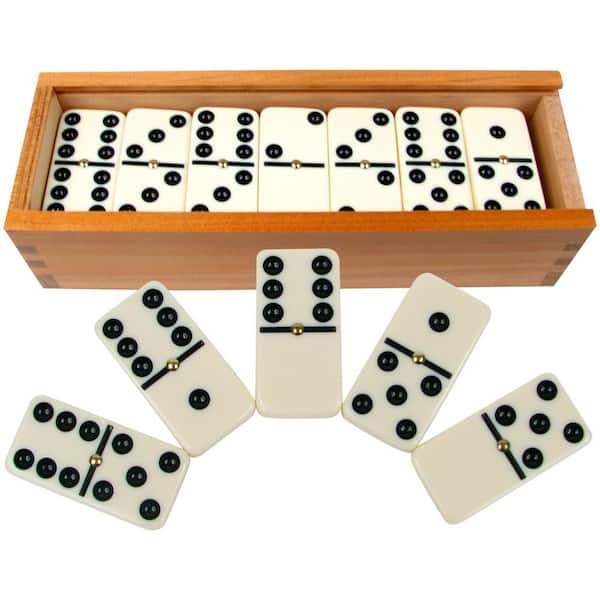
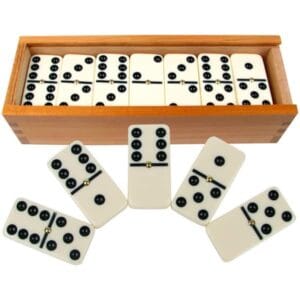
Discover Dominoes, the tile-based abstract strategy game that enhances pattern recognition, planning, strategic thinking, and decision-making skills.

Discover Prodigy Math, the curriculum-aligned math RPG that boosts reasoning, problem-solving, focus, decision-making, and resilience for kids ages 6-14.