
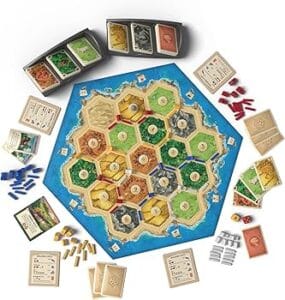
Discover Catan: The Classic Resource Management Strategy Board Game
Explore Catan, the resource management strategy board game that enhances strategic thinking, negotiation, planning, decision-making, and adaptability skills.
Economics games teach you how money moves, how markets behave, and how decisions shape outcomes.
These category of games are incredibly effective because they simulate real systems. You see cause and effect instantly. Raise prices too high? Demand drops. Overproduce? You waste resources. The feedback loop is clear and powerful.
Economics as a field goes back centuries. Think of Adam Smith, who wrote The Wealth of Nations, or John Maynard Keynes, who shaped modern macroeconomics. Their ideas about markets, incentives, and government intervention still influence how economies work today.
Game designers eventually realized that these systems could be simulated. Titles like Monopoly introduced basic property and cash flow concepts, even though it simplifies reality. Later, games like Capitalism, SimCity, and Cities: Skylines allowed players to manage taxes, industries, and public services in more complex ways.
These games turned abstract theory into interactive systems.
Economics games develop practical thinking skills that apply far beyond finance. When you play them, you train your brain to understand interconnected systems.
You strengthen:
Supply and demand reasoning
Budget management
Risk assessment
Long-term planning
Strategic decision-making
However, these games also show something important: every decision has trade-offs. Lower taxes may boost growth, but then public services suffer. Invest heavily in one sector, and you might neglect another.
That tension is real-world economics.
Economics can feel abstract when taught through textbooks alone. Graphs and formulas matter, of course, but they don’t always feel real. In games, they become visible systems.
You test strategies. You fail. You adjust. As a result, you build intuition — not just knowledge. And intuition is what helps people make smarter financial and business decisions in everyday life.
In fact, many business schools now use simulations to teach management and economic strategy. The logic is simple: interactive systems improve understanding.
Here are a few well-known examples:
Monopoly – Basic property management and cash flow
Capitalism Lab – Deep corporate and market simulation
SimCity / Cities: Skylines – Public budgeting and urban economics
Offworld Trading Company – Competitive resource markets
Each one models different aspects of economic behavior.
Understanding economics isn’t just for economists. It helps you interpret news, manage your finances, and understand global events. These category of games make complex systems approachable and hands-on.
They won’t replace formal study. This approach has limits. But they build strong mental models, and that’s a powerful starting point.
When you learn economics by playing, you stop seeing money as random. You start seeing systems. And once you understand the system, you make better decisions.
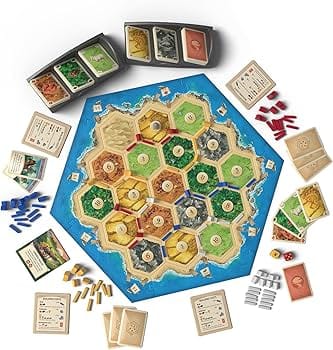
Explore Catan, the resource management strategy board game that enhances strategic thinking, negotiation, planning, decision-making, and adaptability skills.