
Duolingo is the gamified language learning app that helps enhance memory, reading comprehension, vocabulary expansion, attention, and focus. It has revolutionized the way millions approach language acquisition by combining education with engaging gameplay. In this article, we will explore what makes this app so effective, how it works, and why it stands out among language learning tools.
What is Duolingo? An overview
History, Origin
Duolingo was launched in 2011 by Luis von Ahn and Severin Hacker with a mission to make language education free and accessible to everyone. Its unique approach uses gamification elements to motivate users and track progress. Since then, it has grown to become one of the most popular language learning apps worldwide.
Versions and Editions
The app is available in both a free version and a premium subscription called Duolingo Plus, which removes ads and adds offline access. The premium version typically costs around $6.99 to $12.99 per month, depending on the plan. The game supports over 40 languages including Spanish, French, German, Japanese, and many more, catering to a wide audience.
Platform availability
Duolingo is accessible on multiple platforms: iOS, Android, and via web browsers on PC and Mac. This cross-platform availability ensures users can learn anytime, anywhere.
Level of complexity
The app is designed for beginners to intermediate learners but also offers advanced content. Its adaptive learning system adjusts difficulty based on user performance, making it suitable for various skill levels.
Audience & Age
Duolingo targets a broad audience ranging from teenagers to adults. Its friendly interface and bite-sized lessons make it appealing for learners aged 13 and up, including casual learners and those studying for professional or academic purposes.
Educational Value – What skills does Duolingo develop?
- Memory: The app uses spaced repetition techniques to help users retain vocabulary and grammar rules over time.
- Reading comprehension: Lessons involve reading sentences and stories, improving the ability to understand written language.
- Vocabulary expansion: New words are introduced contextually, broadening the learner’s lexicon effectively.
- Attention and focus: Gamified challenges and timed exercises encourage sustained concentration during learning sessions.
Prior knowledge is not required; the app welcomes absolute beginners and gradually builds skills through interactive exercises.
How to play Duolingo?
What does it look like?
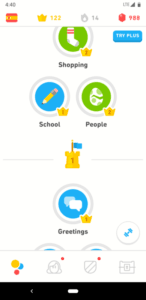
The game is entirely digital, requiring a smartphone, tablet, or computer with internet access. It features a clean, colorful interface with intuitive navigation. Users receive no physical components; instead, they interact with exercises that include listening, speaking, translation, and multiple-choice questions.
Core concept, gameplay style & mechanics
The core gameplay revolves around completing short lessons structured as skill trees. Each lesson combines reading, writing, listening, and speaking tasks. Points, streaks, and virtual rewards motivate continued engagement. The app also uses timed challenges and leaderboards for added competition.
Objective of the game
The main goal is to progress through language levels by mastering vocabulary and grammar, ultimately achieving fluency or proficiency in the chosen language.
Initial Setup and learning curve
Users start by selecting a language and setting a daily practice goal. The app quickly adapts to the learner’s pace, making the learning curve manageable and personalized.
Step-by-step Basic Gameplay Loop
- Choose a lesson or skill to practice.
- Complete exercises involving translation, matching, or speaking.
- Earn points and unlock new lessons.
- Review mistakes and repeat challenging sections.
- Maintain daily streaks to build consistency.
Common mistakes
Many learners rush through lessons without fully grasping concepts, which can hinder retention. Skipping practice on weak areas or neglecting speaking exercises also limits progress.
Expert tips
- Use the app daily for short sessions to build habits.
- Repeat difficult lessons to strengthen weak skills.
- Engage with the speaking exercises to improve pronunciation.
- Supplement app learning with real-life conversations or media.
Alternative games to Duolingo
If you’re looking for other options, Memrise offers immersive video clips and mnemonic techniques to boost vocabulary retention. It’s excellent for visual learners. Meanwhile, Babbel focuses on conversational skills with grammar explanations and speech recognition, making it ideal for practical communication.
FAQ
Is Duolingo free to use?
Yes, Duolingo offers a free version with ads and basic features. A premium subscription removes ads and adds benefits like offline access.
How effective is Duolingo for learning a language?
It is highly effective for building foundational skills, especially vocabulary and grammar, when used consistently. However, combining it with other resources enhances fluency.
Can children use Duolingo?
The app is suitable for users aged 13 and older. Younger learners can use Duolingo Kids, a separate app tailored for children.
Does Duolingo require internet access?
The free version requires internet, but the premium version allows offline downloads for practice without connectivity.
Which languages are available on Duolingo?
Over 40 languages are offered, including popular ones like Spanish, French, German, Japanese, and less common choices like Welsh and Hawaiian.
For Further Learning and Playing
Drops is a great next step after Duolingo. It focuses on vocabulary building through visually appealing, fast-paced mini-games, perfect for learners wanting to expand word knowledge quickly.
Lingodeer offers more structured grammar lessons and cultural context, making it a coherent continuation for those seeking deeper understanding beyond basics.
To sum up
The gamified language learning app that helps enhance memory, reading comprehension, vocabulary expansion, attention, and focus has transformed language education. Its engaging format, broad accessibility, and adaptive learning make it a top choice for beginners and intermediate learners alike.
Sources:
- Duolingo Official Website
- Duolingo – Wikipedia
- TechRadar Duolingo Review
- Common Sense Media – Duolingo
Player Reviews
There are no reviews yet. Be the first one to write one.