
DreamBox Math is a standout adaptive math learning game designed to boost essential skills like mathematical reasoning, problem-solving, pattern recognition, and decision-making. It’s crafted to tailor math lessons to each learner’s pace, making math both engaging and effective. In fact, the adaptive math learning game that helps enhance mathematical reasoning, problem-solving, pattern recognition, decision-making is gaining popularity among educators and parents alike.
What is DreamBox Math? An overview
History, Origin
DreamBox Learning was founded in 2006 with the mission to revolutionize math education through technology. DreamBox Math emerged as a flagship product, combining decades of educational research with cutting-edge adaptive technology. Over the years, it has evolved into a powerful tool used in classrooms and homes worldwide.
Versions and Editions
The game is primarily available as a digital subscription service, accessible via web browsers and mobile apps. Pricing typically ranges from $10 to $20 per month per student, with discounts for schools and families purchasing multiple licenses. DreamBox Math supports English and Spanish languages, making it accessible to a broad audience.
Platform availability
It is compatible with Windows and Mac computers, iPads, and most Android tablets. The game requires a stable internet connection to deliver its adaptive lessons and track progress.
Level of complexity
The game covers math concepts from kindergarten through eighth grade, gradually increasing in difficulty to match the learner’s skill level. Its adaptive engine ensures students are challenged just enough to promote growth without frustration.
Audience & Age
DreamBox Math is designed for children aged 5 to 14, making it ideal for elementary and middle school students. It is also suitable for learners needing extra support or enrichment in math.
Educational Value – What skills does DreamBox Math develop?
- Mathematical reasoning: The game encourages students to think critically about math problems, fostering a deep understanding of concepts rather than rote memorization.
- Problem-solving: Players encounter a variety of challenges that require creative solutions, helping to build flexible thinking skills.
- Pattern recognition: Many activities focus on identifying and predicting patterns, an important foundation for algebra and higher-level math.
- Decision-making: The adaptive nature of the game requires students to make choices about strategies and approaches, reinforcing independent thinking.
Prior knowledge is minimal; the game starts with foundational concepts and adapts as the learner progresses, making it accessible to beginners and those looking to strengthen existing skills.
How to play DreamBox Math?
What does it look like?
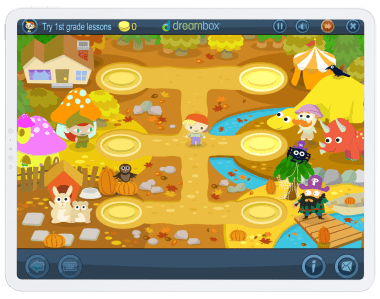
The game is entirely digital. Upon subscription, users gain access to an interactive platform featuring colorful graphics, animated characters, and intuitive controls. It runs smoothly on tablets and computers with standard specifications, requiring a modern browser or app installation. No physical components are necessary.
Core concept, gameplay style & mechanics
The gameplay revolves around adaptive lessons that adjust in real-time based on the student’s responses. It uses a visual and interactive approach to teach math concepts, incorporating puzzles and mini-games that keep learners engaged. The mechanics emphasize exploration, trial, and error, with immediate feedback to guide understanding.
Objective of the game
The main goal is to master math skills progressively, moving through levels that align with educational standards. Players aim to solve problems accurately and efficiently while developing a strong conceptual foundation.
Initial Setup and learning curve
Getting started is simple: after creating an account, the game assesses the learner’s current level through an initial diagnostic. This sets the starting point. The learning curve is smooth, thanks to the adaptive system that personalizes challenges to avoid overwhelming or boring players.
Step-by-step Basic Gameplay Loop
- Begin with a tailored lesson based on prior assessment.
- Engage in interactive activities and puzzles.
- Receive immediate feedback and hints as needed.
- Progress through increasingly challenging topics.
- Track progress via reports and adjust learning paths.
Common mistakes
Some learners may rush through problems without fully understanding concepts, which the game counters by requiring mastery before advancing. Another pitfall is inconsistent playtime, which can slow progress.
Expert tips
- Encourage regular, short sessions for steady improvement.
- Use the detailed progress reports to identify areas needing extra attention.
- Pair the game with offline practice to reinforce skills.
- Leverage the hints and feedback rather than skipping them.
Alternative games to DreamBox Math
If you’re exploring other options, ST Math is a strong alternative. It uses visual puzzles to teach math concepts through spatial-temporal reasoning. Another popular choice is Prodigy Math Game, which combines role-playing game elements with math challenges, making learning adventurous and fun.
FAQ
What age group is DreamBox Math suitable for?
DreamBox Math is designed for children aged 5 to 14, covering kindergarten through eighth grade.
Is DreamBox Math aligned with school curriculums?
Yes, the game aligns with Common Core State Standards and other educational benchmarks, making it compatible with school learning objectives.
Does DreamBox Math require internet access?
Yes, a stable internet connection is necessary to access the adaptive lessons and sync progress.
Can DreamBox Math be used for homeschooling?
Absolutely. Its personalized approach and comprehensive coverage make it an excellent tool for homeschooling parents.
Are there any free trials available for DreamBox Math?
DreamBox Learning typically offers free trials or demo versions for families and educators to explore the platform before subscribing.
For Further Learning and Playing
After mastering DreamBox Math, learners can continue their math journey with DragonBox Algebra 5 and DragonBox Algebra. These games build on foundational skills by introducing algebraic thinking and more advanced problem-solving. They are a coherent continuation because they maintain an engaging, visual approach while deepening mathematical understanding.
To sum up
DreamBox Math stands out as an adaptive math learning game that effectively enhances mathematical reasoning, problem-solving, pattern recognition, and decision-making. Its personalized approach, engaging gameplay, and solid educational foundation make it a top choice for young learners.
Sources
DreamBox Learning Official Website
Concordia University: What is DreamBox?
Common Sense Education Review of DreamBox
Player Reviews
There are no reviews yet. Be the first one to write one.