
When it comes to classic board games, few are as iconic as Battleship. This guessing strategy game has entertained and challenged players for decades, combining fun with a mental workout. Battleship is often celebrated as the turn-based guessing strategy game that helps enhance deductive reasoning, pattern recognition, planning and foresight, and decision-making. Whether you’re playing casually or aiming to master its tactics, the game offers a timeless experience that continues to captivate.
What is Battleship? An overview
History, Origin
Battleship traces its origins back to the early 20th century as a pencil-and-paper game played by naval officers. It evolved into a commercial board game in the 1930s and gained widespread popularity after Milton Bradley released a plastic version in the 1960s. Since then, it has become a staple in households worldwide, renowned for its simple yet strategic gameplay.
Versions and Editions
Over the years, Battleship has seen numerous editions, including travel-size sets, electronic versions, and themed variants based on popular franchises. Prices typically range from $15 to $40 depending on the edition and retailer. The game is widely available in multiple languages such as English, Spanish, French, German, and Japanese, making it accessible globally.
Platform availability
While traditionally a physical board game, Battleship also has digital versions playable on smartphones, tablets, and PCs. This allows for both solo play against AI and online multiplayer matches.
Level of complexity
The game is easy to learn but hard to master. It is suitable for beginners and casual players but also offers depth for those who enjoy strategic planning and deductive challenges.
Audience & Age
Battleship is generally recommended for ages 7 and up. Its straightforward rules make it ideal for children, families, and adults alike. The game appeals to anyone interested in strategy, logic, and friendly competition.
Educational Value – What skills does Battleship develop?
- Deductive reasoning: Players infer the location of opponent ships based on hits and misses, honing logical thinking.
- Pattern recognition: Spotting patterns in previous guesses helps predict ship placement and improves accuracy.
- Planning and foresight: Anticipating opponent moves and strategically selecting targets requires forward-thinking.
- Decision-making: Choosing where to guess next under uncertainty builds confidence in making informed decisions.
No prior knowledge is necessary to enjoy the game, but basic understanding of coordinates and grids helps players get started quickly.
How to play Battleship?
What does it look like?
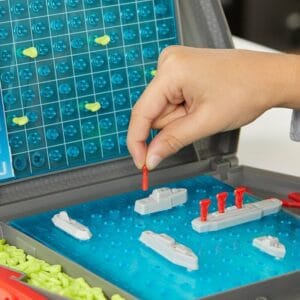
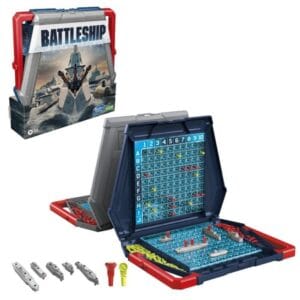
When you purchase the physical game, you typically receive two plastic grids, a set of ships of varying sizes, and pegs for marking hits and misses. The grids represent the ocean where ships are hidden. For digital versions, the game runs on most modern smartphones, tablets, and computers with minimal technical requirements.
Core concept, gameplay style & mechanics
The game is turn-based, with players taking turns guessing coordinates on the opponent’s grid to find and sink their ships. Each ship occupies a certain number of consecutive squares, and the goal is to locate all parts of every ship before your opponent does.
Objective of the game
The objective is simple: sink all of your opponent’s ships before they sink yours. It’s a battle of wits and strategy, requiring careful targeting and deduction.
Initial Setup and learning curve
Players secretly place their ships on their grid either horizontally or vertically. The learning curve is gentle, with basic rules easily grasped in minutes. However, mastering effective guessing and strategic placement can take practice.
Step-by-step Basic Gameplay Loop
- Each player places their ships on their grid.
- Players alternate turns calling out grid coordinates to attack.
- The opponent announces if the guess is a “hit” or “miss.”
- Hits are marked on the attacking player’s tracking grid; misses are marked as well.
- Continue until one player sinks all opponent ships.
Common mistakes
- Random guessing without strategy wastes turns.
- Over-concentrating guesses in one area too early.
- Neglecting to track previous hits and misses carefully.
- Placing ships in predictable patterns.
Expert tips
- Use a systematic pattern for initial guesses to cover more area efficiently.
- Once a hit is found, focus on adjacent squares to locate the entire ship.
- Vary ship placement to avoid being predictable.
- Keep detailed notes or use the tracking grid diligently.
Alternative games to Battleship
If you enjoy this game, you might also like Guess Who? and Mastermind. Both are turn-based strategy games that focus on deduction and pattern recognition. Guess Who? challenges players to identify a character by asking yes/no questions, while Mastermind involves cracking a secret code through logical guesses. These games complement Battleship well, offering different twists on strategic thinking.
FAQ
What is the recommended age for Battleship?
Most versions of the game recommend players aged 7 and up, making it suitable for children and adults alike.
How many players can play Battleship?
The game is designed for two players, engaging in head-to-head strategic battles.
Can Battleship be played online?
Yes, there are digital versions available on multiple platforms that allow online multiplayer matches.
How long does a typical game last?
Games usually last between 20 to 40 minutes, depending on player experience and strategy.
Is prior knowledge required to play?
No, the game is easy to learn and requires no prior experience. Basic understanding of grids and coordinates helps but is not mandatory.
For Further Learning and Playing
Once you’ve mastered Battleship, you might want to explore Stratego and Risk. Stratego builds on similar strategic foundations, involving hidden pieces and tactical movement on a board, deepening planning and deception skills. Risk expands into global domination strategy, requiring alliance-building, risk assessment, and long-term planning. Both games offer a natural progression for players who enjoy strategic, turn-based challenges like Battleship.
To sum up
Battleship remains a beloved classic that combines simple rules with strategic depth. As the turn-based guessing strategy game that helps enhance deductive reasoning, pattern recognition, planning and foresight, and decision-making, it offers fun and mental exercise for all ages. Whether you’re new or seasoned, it’s a game worth playing and mastering.
Sources:
Player Reviews
There are no reviews yet. Be the first one to write one.