
Catan is a captivating resource management strategy board game that has won the hearts of millions worldwide. It’s not just a game but a tool that helps enhance strategic thinking, negotiation and persuasion, planning and foresight, decision-making, and adaptability. Whether you are a casual player or a strategy enthusiast, it offers an engaging experience that sharpens your cognitive and social skills.
What is Catan? An overview
History, Origin
The game was originally designed by Klaus Teuber and first published in 1995 in Germany under the name “Die Siedler von Catan” (The Settlers of Catan). It quickly became a worldwide phenomenon, credited with popularizing German-style board games internationally. Since its debut, it has won numerous awards and has been translated into over 30 languages.
Versions and Editions
Over the years, the game has evolved with multiple expansions like Seafarers, Cities & Knights, and Traders & Barbarians, each adding new layers of strategy and complexity. The base game typically ranges from $40 to $60 depending on the edition and retailer. It is widely available in English, German, French, Spanish, Italian, and many other languages, making it accessible to players globally.
Platform availability
While originally a physical board game, Catan has embraced digital platforms. It can be played on PC, iOS, Android, and various gaming consoles, allowing players to enjoy it solo or online with friends.
Level of complexity
The game is considered moderately complex. It’s easy to learn for beginners but offers enough depth for experienced players to develop advanced strategies.
Audience & Age
Catan is suitable for players aged 10 and up. It appeals to families, casual gamers, and strategy enthusiasts alike, making it a versatile choice for game nights and educational settings.
Educational Value – What skills does Catan develop?
- Strategic thinking: Players must plan their settlements and road placements carefully to maximize resource gain and expansion opportunities.
- Negotiation and persuasion: Trading resources with other players involves negotiation skills that can influence the outcome of the game.
- Planning and foresight: Anticipating opponents’ moves and planning long-term strategies are key to success.
- Decision-making: Each turn requires players to make critical choices about resource use, trading, and development.
- Adaptability: The game board changes dynamically, and players must adjust their strategies accordingly.
Prior knowledge of basic resource management and turn-based gameplay helps but is not required to enjoy the game.
How to play Catan?
What does it look like?
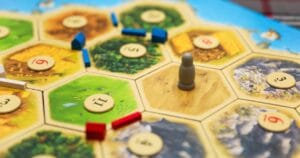
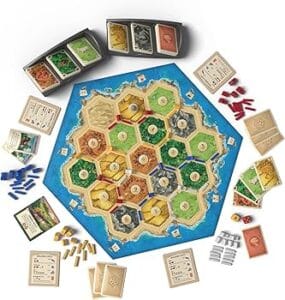
The physical game includes a modular hexagonal board representing different terrains, resource cards (wood, brick, wheat, sheep, and ore), development cards, roads, settlements, cities, and a robber token. The components are colorful and tactile, designed to enhance the gaming experience. For digital versions, a computer or mobile device with internet access is required, and the game runs smoothly on most modern systems.
Core concept, gameplay style & mechanics
The core concept revolves around players building settlements and roads to gather resources. These resources are then used to expand their territory and earn victory points. The gameplay combines luck (dice rolls) with strategy (placement and trading), creating a balanced and dynamic experience.
Objective of the game
The objective is to be the first player to reach 10 victory points. Points are earned by building settlements and cities, having the longest road, the largest army, and acquiring development cards.
Initial Setup and learning curve
Players arrange hexagonal terrain tiles randomly to form the island of Catan. Settlements and roads are placed strategically at the start. The learning curve is gentle; new players can grasp the basics within one or two sessions, while mastery comes with experience.
Step-by-step Basic Gameplay Loop
- Roll dice to determine resource production.
- Collect resources from hexes adjacent to your settlements and cities.
- Trade resources with other players or the bank.
- Build roads, settlements, or cities, or buy development cards.
- End turn and pass play to the next player.
Common mistakes
- Overexpanding too quickly without securing resources.
- Ignoring trading opportunities with other players.
- Failing to adapt to changing board conditions.
Expert tips
- Focus on balancing resource diversity to avoid shortages.
- Use negotiation to your advantage; sometimes trading less can yield better long-term benefits.
- Pay attention to opponents’ strategies and block them strategically with the robber.
Alternative games to Catan
If you enjoy this resource management strategy board game, you might also like Ticket to Ride and Carcassonne. Ticket to Ride offers a simpler yet strategic railway-building experience that focuses on route planning and card collection. Carcassonne is a tile-placement game that emphasizes spatial reasoning and area control. Both are excellent alternatives that provide engaging gameplay and are great for families and casual gamers.
FAQ
What is the best number of players for Catan?
The game is best enjoyed with 3 to 4 players, which allows for balanced competition and interaction. However, expansions can support up to 6 players.
How long does a typical game take?
A standard game usually lasts between 60 to 90 minutes, depending on player experience and the number of participants.
Can Catan be played online?
Yes, there are official digital versions available for PC, mobile devices, and consoles, allowing you to play solo or with friends remotely.
Is Catan suitable for children?
It is recommended for ages 10 and up due to the strategic and negotiation elements involved.
Does Catan require math skills?
Basic arithmetic is helpful but not essential. The game focuses more on strategy and negotiation than complex calculations.
For Further Learning and Playing
Power Grid is an excellent next step after mastering Catan. It deepens economic strategy by focusing on resource auctions and network building, offering a more complex challenge for players who enjoyed resource management and planning.
Brass: Birmingham is another logical progression. It introduces industrial revolution themes with intricate economic mechanics and strategic depth, perfect for those who appreciate Catan’s blend of strategy and adaptability.
To sum up
Catan is a timeless resource management strategy board game that combines luck, strategy, and social interaction. It fosters critical skills such as strategic thinking, negotiation, planning, decision-making, and adaptability, making it both fun and educational.
Sources:
Player Reviews
There are no reviews yet. Be the first one to write one.